

Simple Analogy: Building a House
Think of a website or a web application, such as Facebook, Amazon, or your bank’s website as a house.
Web development consists of the tasks involved in building a house — the digging of the foundation, the construction of the walls, the installation of the electric wiring, and so on.
The Formal Definition
The creation, building, and maintaining of websites and web applications that are viewed in a web browser over the internet is referred to as web development. It can involve the simplest single static page of plain text or more complicated web-based applications, electronic businesses, and social network services.
Three Main Layers of Web Development
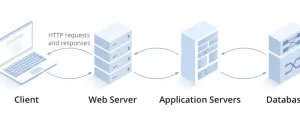
The modern web development is usually divided into three areas usually referred to as the client-server-database or the frontend-backend-database triad.
1. Front-End Development (The “Client-Side”) Essay
This part is seen and interacted with by the end-users in their browsers. It is typically the part of the website that is directly viewed by the consumer.
It can be compared to the interior design, paintwork, furniture, and overall decoration of the house – the things that a person would see and could interact with directly. The main tools used in this stage are:
HTML (HyperText Markup Language) – responsible for the content and basic structure of the website;
CSS (Cascading Style Sheets) – responsible for the presentation and appearance of the website;
JavaScript – responsible for the dynamic behavior and scripts of the website.
The role of a web developer here is linked to the Front-End Developer or UI/UX Designer positions.
2. Back-End Development (The “Server-Side”)
This stage involves the tools and procedures that enable the proper functioning of the website but are not seen directly by the consumers. It can be compared to the electrical engineering, plumbing, and other utilities of the house – the parts that make the house suitable for living but are not visible at first glance.
The main components of the Back-End development include:
Server – the computer program that hosts the website’s core files and data;
Application – the set of instructions in a programming language that directs the operation of the website;
Database – the storage compartment for the website’s data.
The primary programming languages used in Back-End development are Python, PHP, Ruby, Java, C#, Node.js, etc. Some popular frameworks are Django (Python), Laravel (PHP), Ruby on Rails, Spring (Java), etc. The role of a web developer here is linked to the Back-End Developer position.
3. Full-Stack Development
A Full-Stack Developer is a developer that can be considered a ‘universal’ problem-solver with practical knowledge of both Front-End and Back-End development tools and procedures. The understanding of the End-User interaction and the technical side of web development enable such specialists to work on small individual projects or large-scale systems.
It can be compared to the position of a general contractor in the construction industry – someone that has the necessary skills to take on a big project or delegate tasks to more specialized workers. In terms of the Web Development process, a Full-Stack Developer can oversee the creation of a website, distribute tasks to other developers, if necessary, consult with clients, establish project specifications, and manage the development process.
Overall, a typical workflow for a Web Developer can be outlined as follows:
Project analysis and specification – determining the purpose of the website and its target audience;
Design – developing a website prototype with particular attention to the user interface (UI) and user experience (UX); this task is often assigned to a separate UI/UX Designer;
Front-End development – building the website’s UI/UX using the Front-End tools;
Back-End development – developing the tools and procedures for the proper functioning of the website;
Testing – testing the website for possible UI/UX issues and technical bugs;
Launch – deploying the final version of the website to the public;
Maintenance – providing continuous support and making updates to the website’s content, performance, and security.
The importance of web development should also be emphasized. First of all, web development is crucial for the functioning of the modern global business environment. A variety of websites enable companies to operate online 24/7 and serve as the foundation for e-commerce. In addition, the communication infrastructure relies on the web development industry to provide online platforms for publishing articles, maintaining blogs, facilitating social communication, and other useful functions.
Finally, the online entertainment industry would not exist without web developers and designers. A wide variety of video content, ranging from casual YouTube videos to entire television series, is hosted on the websites developed and maintained by web developers. Popular streaming services like Google YouTube, Netflix, Amazon Prime Video, and many other provide users with thousands of hours of video content every day.