

The Simple Answer
Data Science is the field of extracting knowledge and insights from data.
Think of it as a blend of various tools, algorithms, and machine learning principles aimed at discovering hidden patterns from raw data. It’s like being a detective, but for data.
The Analogy: The Gold Mine
Imagine a huge, unexplored mountain (the data). A data scientist’s job is to:
- Find the mountain and get permission to mine (Data Acquisition & Business Understanding).
- Dig out the raw ore (Data Collection).
- Clean the ore and remove dirt and rocks (Data Cleaning & Preprocessing). This is often the most time-consuming part!
- Analyze the ore to find the veins of gold (Exploratory Data Analysis & Model Building).
- Extract and refine the pure gold (Building Predictive Models & Generating Insights).
- Shape the gold into a valuable product, like jewelry or coins (Data Visualization & Storytelling) that the business can use to make decisions.
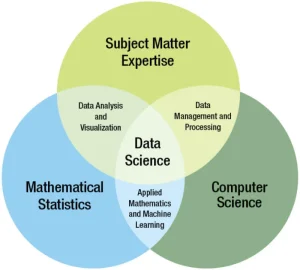
The Core Components (The Venn Diagram)
A popular way to visualize Data Science is as an intersection of three key fields:
- Computer Science: The programming and engineering skills to handle large datasets (Big Data) and build algorithms.
- Mathematics & Statistics: The foundation for understanding patterns, performing analysis, and building models. This includes probability, linear algebra, and calculus.
- Domain Knowledge: Expertise in the specific field you’re working in (e.g., finance, healthcare, marketing). This is crucial for asking the right questions and interpreting the results correctly.
Communication and Storytelling is the glue that holds it all together, turning complex results into actionable business recommendations.
The Data Science Lifecycle (The Process)
A data science project typically follows a structured process, often called the Data Science Lifecycle. Key steps include:
- Problem Definition: What business problem are we trying to solve?
- Data Acquisition: Gathering data from databases, APIs, web scraping, etc.
- Data Preparation & Cleaning: Handling missing values, correcting errors, and formatting data. (This is ~80% of the work!)
- Exploratory Data Analysis (EDA) & Visualization: Using statistics and charts to understand the data’s patterns, trends, and relationships.
- Model Building: Applying machine learning algorithms to the data to create predictive or descriptive models.
- Model Evaluation & Validation: Testing the model to see how well it performs on new, unseen data.
- Model Deployment: Putting the model into a live production environment where it can start providing value.
- Communication & Storytelling: Presenting the findings and insights to stakeholders in a clear, compelling way.
Key Techniques & Tools
- Machine Learning: Teaching computers to learn from data without being explicitly programmed for every task. This includes predictive modeling, classification, and clustering.
- Statistical Analysis: Using statistical methods to understand data, test hypotheses, and quantify relationships.
- Programming: Primarily using Python (with libraries like Pandas, NumPy, Scikit-learn) and R.
- Data Visualization: Using tools like Tableau, Power BI, or libraries like Matplotlib and Seaborn to create charts and dashboards.
- Big Data Technologies: Handling massive datasets with tools like SQL, Spark, and Hadoop.
Real-World Examples
- Netflix & Spotify: Their recommendation engines (“Because you watched…”) are classic data science applications.
- Healthcare: Predicting disease outbreaks or analyzing medical images for early diagnosis.
- Finance: Detecting fraudulent credit card transactions in real-time.
- E-commerce: Optimizing pricing, forecasting sales, and personalizing marketing campaigns.
- Self-Driving Cars: Using computer vision (a form of data science) to recognize objects and navigate roads.
In a Nutshell
| It’s NOT just… | It IS… |
|---|---|
| Just Statistics | Statistics + Programming + Domain Knowledge |
| Just Coding | Solving business problems with data-driven solutions |
| Just about Building Models | About the entire process, from question to deployment to impact |
| Magic | A rigorous, iterative, and often messy process of discovery |
In essence, data science is a powerful discipline that turns raw data into understanding, actionable insights, and competitive advantage.
[INSERT_ELEMENTOR id=”17″]