


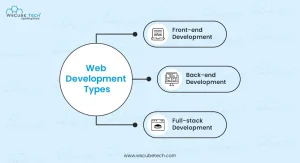
The Three Core Types of Web Development
These three types work together to create a fully functional and visually appealing website or application.
1. Front-End Development (Client-Side)
This is what users see and interact with directly in their web browser. Front-end developers are responsible for the look, feel, and interactive elements of a website.
- Core Responsibilities:
- Implementing visual elements (layout, typography, images, colors).
- Ensuring the site is responsive (works well on desktops, tablets, and phones).
- Handling user input (clicks, form submissions, scrolling).
- Optimizing for performance and speed.
- Essential Technologies:
- HTML (HyperText Markup Language): The skeleton and structure of a web page.
- CSS (Cascading Style Sheets): The skin and clothing; used for styling and layout.
- JavaScript: The muscles and brain; adds interactivity and dynamic behavior.
- Popular Frameworks & Libraries:
- React: A library from Facebook for building user interfaces, especially single-page applications.
- Angular: A full-fledged framework from Google for building complex applications.
- Vue.js: A progressive framework known for its simplicity and flexibility.
- Svelte: A newer compiler-based framework that shifts work from the browser to the build step.
- Common Job Titles: Front-End Developer, UI/UX Developer, Web Designer (sometimes).
2. Back-End Development (Server-Side)
This is the part that runs on the server, invisible to the user. It’s the logic, database interactions, and server configuration that power the front-end.
- Core Responsibilities:
- Building and maintaining the server, application, and database.
- Creating APIs (Application Programming Interfaces) for the front-end to consume.
- Managing user authentication and authorization.
- Ensuring data security and backup.
- Core Components:
- Server: The computer that hosts the website files and back-end code (e.g., Apache, Nginx).
- Application: The business logic written in a back-end programming language.
- Database: Where persistent data is stored (e.g., user profiles, product information).
- Popular Technologies:
- Programming Languages: Python, PHP, Ruby, Java, C#, Node.js (JavaScript on the server).
- Frameworks: Django (Python), Laravel (PHP), Ruby on Rails (Ruby), Spring (Java), Express (Node.js).
- Databases: MySQL, PostgreSQL (Relational/SQL), MongoDB, Firebase (Non-relational/NoSQL).
- Common Job Titles: Back-End Developer, Software Engineer, DevOps Engineer.
3. Full-Stack Development
A full-stack developer is a generalist who is comfortable working with both the front-end and back-end parts of a web application. They have a broad understanding of how all the pieces fit together.
- Core Responsibilities:
- Can handle projects that involve building and maintaining entire web applications.
- Understands the complete flow of data, from the user interface to the server and database.
- Can often configure servers and manage deployment.
- Skill Set: A combination of all the front-end and back-end technologies mentioned above. They are often “T-shaped” professionals—deeply skilled in one or two areas but knowledgeable across the entire stack.
- Common Job Title: Full-Stack Developer.
Other Specialized Types of Web Development
As the field has evolved, many developers have chosen to specialize further.
4. DevOps (Development Operations)
A blend of development and IT operations. DevOps engineers focus on the tools, processes, and methodologies to balance needs throughout the software development life cycle, from coding and deployment to maintenance and updates.
- Focus: Automation, continuous integration/continuous deployment (CI/CD), cloud infrastructure (AWS, Azure, Google Cloud), containerization (Docker, Kubernetes), and monitoring.
5. Mobile-First / Responsive Development
While not a separate layer, this is a crucial specialization focused on creating websites that provide an optimal viewing experience across a wide range of devices. It often involves a “mobile-first” approach, where the site is designed for mobile devices first and then scaled up for larger screens.
6. Web3 Development
A rapidly emerging field focused on building decentralized applications (dApps) that run on blockchain technology.
- Focus: Smart contracts (often written in Solidity), blockchain integration (Ethereum, Solana), and cryptocurrencies.
7. Progressive Web App (PWA) Development
PWAs are websites that look and feel like a native mobile app. They can work offline, send push notifications, and be installed on a user’s home screen.
- Focus: Service Workers, Web App Manifests, and advanced caching strategies.
Summary Table
| Type of Development | Focus Area | Key Technologies | Analogy |
|---|---|---|---|
| Front-End | What the user sees and interacts with in the browser. | HTML, CSS, JavaScript, React, Vue | The interior design, paint, and dashboard of a car. |
| Back-End | The server, database, and application logic. | Python, PHP, Node.js, SQL, MongoDB | The engine, fuel system, and internal mechanics of a car. |
| Full-Stack | The entire application, both front-end and back-end. | A combination of all the above. | A master mechanic who can work on every part of the car. |
| DevOps | The deployment, automation, and infrastructure. | AWS, Docker, Kubernetes, CI/CD | The factory assembly line and logistics team. |
Choosing a path depends on your interests. If you love visual design and user experience, go for front-end. If you enjoy logic, data, and problem-solving, back-end might be for you. If you want to understand the big picture, become a full-stack developer.
[INSERT_ELEMENTOR id=”17″]