
1. For Absolute Beginners: High-Level Conceptual Overview
These courses focus on the “what” and “why” of AI without heavy math or coding.
Google’s AI for Anyone
- Channel: Google
- Link: Google’s AI for Anyone
- Why it’s great: This is arguably the best starting point for a non-technical person. It explains core concepts like Data, Machine Learning, and Neural Networks in a very accessible way, using great analogies. It demystifies AI without requiring any prior knowledge.
AI for Everyone by Andrew Ng (DeepLearning.AI)

- Channel: DeepLearning.AI
- Link: AI for Everyone
- Why it’s great: Created by the legendary Andrew Ng, this course is designed for business professionals and anyone who wants to understand how to apply AI in a company. It covers AI strategy, workflow, and ethical implications. The presentation is incredibly clear and professional.
2. For Aspiring Practitioners & Programmers
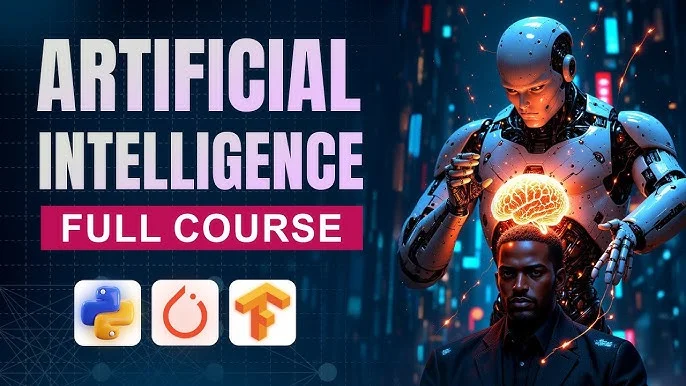
These are for those who want to get their hands dirty with code, primarily in Python. They often use popular libraries like TensorFlow and PyTorch.
Machine Learning Course for Beginners by Ayush Singh
- Channel: FreeCodeCamp.org
- Link: Machine Learning for Beginners
- Why it’s great: A massive, 10-hour comprehensive course from FreeCodeCamp. It’s project-based, meaning you learn by building things. It covers the entire pipeline from data preprocessing to complex models like Neural Networks and NLP. Perfect if you have basic Python knowledge and want to dive in.
Neural Networks by 3Blue1Brown
- Channel: 3Blue1Brown
- Link: Neural Networks Playlist
- Why it’s great: This isn’t a coding course, but it is essential viewing for anyone wanting to understand how neural networks work. The visual animations are unparalleled for building an intuitive grasp of the underlying mathematics (like gradient descent and backpropagation) without feeling overwhelming.
Complete Deep Learning Course by Henry AI Labs

- Channel: Henry AI Labs
- Link: Full Deep Learning Course
- Why it’s great: A very well-structured and modern course that goes from the basics all the way to advanced topics like Transformers and Graph Neural Networks. It’s great for someone who wants a rigorous, code-along approach.
3. For University-Level Depth & Theory
These are full recordings of actual university courses. They are more theoretical and math-heavy but provide a deep, foundational understanding.
MIT 6.S191: Introduction to Deep Learning
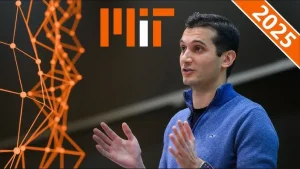
- Channel: MIT
- Link: MIT Introduction to Deep Learning
- Why it’s great: This is a modern, fast-paced, and excellent introduction to Deep Learning from one of the world’s top universities. The lectures are updated yearly and cover state-of-the-art topics like LSTMs, Deep Reinforcement Learning, and Ethical AI. The production quality is high.
Stanford CS229: Machine Learning (Old but Gold)

- Channel: Stanford Online
- Link: Stanford CS229 – Machine Learning
- Why it’s great: This is the original Machine Learning course taught by Andrew Ng. It’s a classic and provides a rigorous, mathematical foundation for the field. While the lectures are older, the core theory is timeless. Perfect for those who want to understand the “why” behind the algorithms.
Stanford CS25: Transformers United V2
- Channel: Stanford Online
- Link: CS25: Transformers United
- Why it’s great: Transformers are the architecture behind LLMs like GPT and Claude. This seminar series is the best resource on the internet to deeply understand how they work, featuring talks from leading researchers. It’s advanced but invaluable.
Quick Guide: Which One Should YOU Choose?
- “I have no tech background and just want to understand the news.”
- Start with Google’s AI for Anyone or Andrew Ng’s AI for Everyone.
- “I know some Python and want to build my first AI model.”
- Go for the FreeCodeCamp ML Course. Then, watch the 3Blue1Brown playlist for intuition.
- “I’m a student and want a deep, university-style education.”
- Enroll yourself in MIT 6.S191 for a modern take or Stanford CS229 for a classical, mathematical foundation.
- “I want to understand the latest in Large Language Models (LLMs).”
- After getting the basics, dive into Stanford CS25: Transformers United.
No matter which you choose, the best way to learn is to watch actively and code along. Pause the videos, try to implement the concepts yourself, and don’t be afraid to rewatch difficult sections. Happy learning
[INSERT_ELEMENTOR id=”17″]