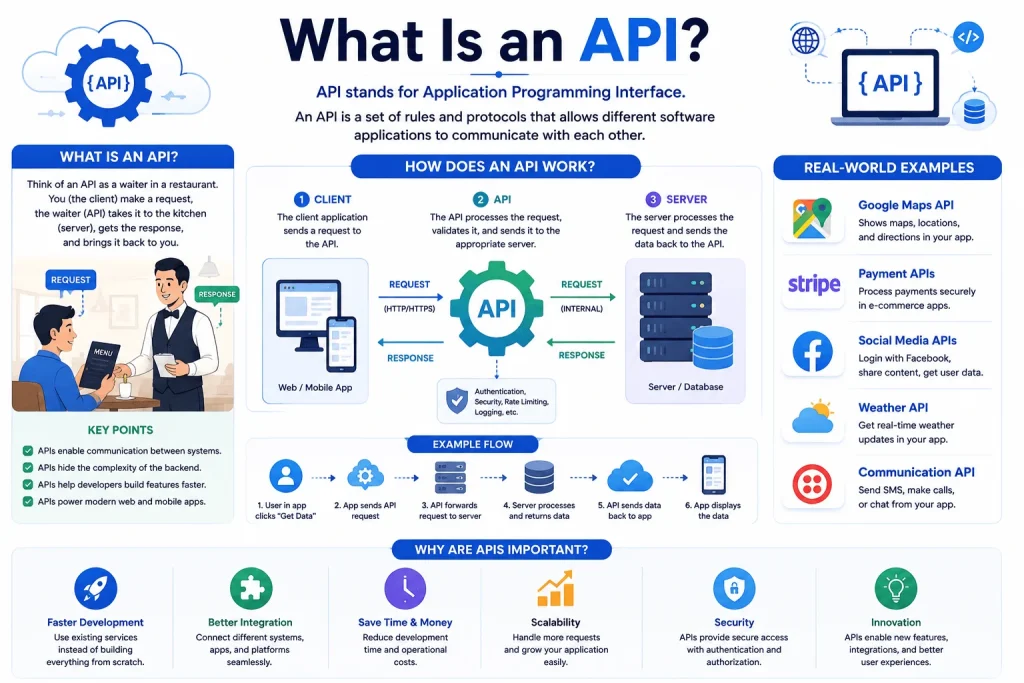

What is an API. What does API stand for?
Define API, which stands for Application Programming Interface in terms.
Explain what an API does.
Give a real world analogy for an API.
Explain why APIs are important in software.
How do APIs work?
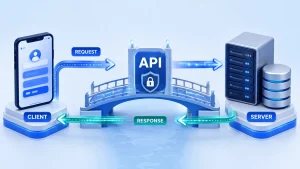
How do applications communicate through APIs?
API requests and responses.
API endpoints.
HTTP methods such as GET, POST, PUT and DELETE.
Common API data formats such, as JSON and XML.
What Are the Different Types of APIs?
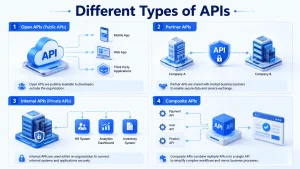
What Are the Different API Access Models?
Private APIs for internal systems
APIs available to developers
Partner APIs, for selected organizations
Composite APIs that combine multiple operations
What Is an API Endpoint and Why Does It Matter?
What an endpoint is
How endpoints identify API resources
Parameters and request data
The role of endpoints in API security and performance
What are API integrations?
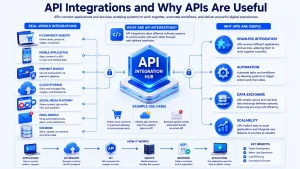
Connecting applications and services
Automation and data exchange
Benefits such as integration, scalability, innovation and easier maintenance
Examples of APIs in applications
How do you secure an API?
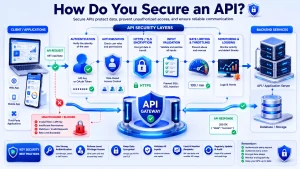
Why API security matters
API keys are codes that let me access a service.
Authentication tokens are pieces of data that prove my identity.
Authorization decides what I can do after I am authenticated.
HTTPS and other common security practices keep my data encrypted during transit.
Protecting data and preventing abuse is the main goal of all these practices.
How do you. Test an API?
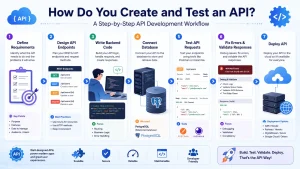
I start by planning the requirements.
Planning API requirements means deciding what the API will do. Who will use it.
Designing and building endpoints involves creating URLs that do useful work for me.
Testing API requests and responses makes sure the API behaves as I expect.
Handling errors means giving messages when something goes wrong.
Documenting and maintaining the API keeps me and other developers informed and the service stable.
How do you. Document an API?
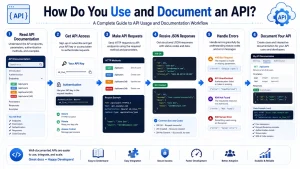
I start by reading API documentation
I then get authentication credentials to access the API.
I send requests to the API. Watch the response.
I understand responses by looking at the API data format.
I use API documentation tools and best practices to stay organized.
I find APIs for development projects by searching online directories.
I ask myself what is an API gateway and why API gateway is used by the API community.
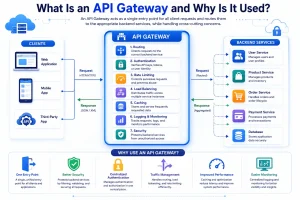
I learn what an API gateway does by studying API gateway features.
I see how API gateway routes. Manages API requests, across many services.
I check how API gateway handles authentication and rate limiting for the API.
I monitor performance and metrics provided by the API gateway to keep the system healthy.
I discover how API gateways fit into applications by mapping the architecture.
This structure flows naturally from a definition to how APIs work to types to architecture to benefits to security to development to usage and finally to advanced concepts. It gives you a foundation for a detailed article without any unnecessary sections.
Section four focuses on who can access an API and how that access is controlled. Here is a detailed version that follows naturally from the section.
What Are the Different API Access Models?
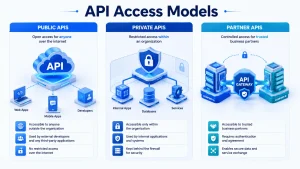
There is another way to categorize APIs based on who can access them. An organization can develop an API that’s only accessible by its own applications by business partners or even by the general public.
The popular API access models include private APIs, public APIs, partner APIs and composite APIs.
**Private APIs**
APIs also called internal APIs are designed for use inside an organization. They are not normally available to the public.
A company may use APIs to connect different internal systems and applications. For example an e-commerce company might have systems for customers, inventory, payments and shipping. Private APIs can allow these systems to talk to each other.
Private APIs can help organizations:
Connect internal applications
Share data between departments
Automate processes
Reduce duplicated development work
Improve communication between services
For example an internal employee application could use a private API to retrieve information from the companys employee database.
Because private APIs are intended for trusted users or applications access can be controlled through authentication and authorization.
**Public APIs**
APIs also called open APIs are those that can be accessed by developers from outside the organization.
Public APIs are usually provided by organizations so that developers can incorporate their services into applications or software.
For instance a company may offer an API that lets developers access maps, payment gateways, weather details and so on.
Public APIs can help companies:
Reach more developers
Encourage third‑party integrations
Build an ecosystem around their services
Increase the usefulness of their products
Create business opportunities
The term “public” does not always mean there are no restrictions. Some public APIs are still secured with an API key, an account, authentication or some type of request limitation.
Another way to limit the number of requests a client makes is to use rate limiting.
**Partner APIs**
Partner APIs are designed for external organizations or business partners. Unlike APIs partner APIs are not widely accessible to everyone.
For example an online retail company can provide a partner API to a shipping company. The partner can use that API to get order information and update shipment status.
A partner API is convenient when least two companies want to share data or merge their software.
Common uses include:
Business‑to‑business integrations
Payment processing
Shipping and logistics
Customer relationship management
Supply chain systems
Financial services
Access is usually controlled strictly than with public APIs. Partners may need to authenticate themselves and follow security and usage requirements.
**Composite APIs**
Composite APIs combine API operations or requests into a single API call.
Without an API an application might need several separate requests to complete one task.
For example an e-commerce application might need to:
retrieve customer information
check product availability
calculate shipping costs
create an order
process payment
A API can combine multiple operations into one request or workflow.
This can reduce the number of requests between the client and server.
Composite APIs can be particularly useful, in applications and microservices architectures, where different services handle different parts of an application.
Why Do API Access Models Matter?
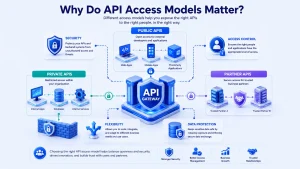
Selecting the access model allows an organization to manage how its APIs are utilized.
A business that develops software often chooses a private API. A company that encourages developers to create integrations typically offers an API. A firm that collaborates closely with chosen organizations usually adopts partner APIs.
Composite APIs address a challenge. They combine operations making communication easier and boosting efficiency.
Security matters for all access models. Even public APIs require controls to stop unauthorized use limit excessive requests and prevent misuse.
Private vs Public vs Partner APIs
The differences become clearer when you compare their users:
| API Model | Who Can Access It? | Common Purpose |
|—|—|—|
Private API | Internal teams and applications | Connecting internal systems |
| Public API | External developers or users | Providing services to third‑party applications |
| Partner API | Approved business partners | Business integrations |
| Composite API | Authorized clients | Combining multiple API operations |
Understanding these access models helps developers design APIs that match their business goals. The next essential idea is an API endpoint, which describes how and where a client reaches the API resource.
Please provide content for Section 5 of the outline.
Section 5 focuses on a part of any API – the API endpoint. It also examines how endpoints relate to security, performance and API development.
An API endpoint is the URL where a client sends requests and receives responses. It is the address that tells the application where to look for the data or action it needs. Think of it as the door of a building – it must be clear, safe and easy to find.
Security around an API endpoint starts with authentication and authorization. Every request should prove the identity of the caller. Check whether the caller has permission to perform the action. Tokens, API keys or OAuth are ways to enforce this. Without checks an endpoint can become a doorway for attackers.
Performance is another concern. A well‑designed endpoint reduces the amount of data transferred limits the number of round‑trips and uses caching where possible. Pagination, filtering and efficient query design help keep response times server load low. Remember, an endpoint that is slow or unreliable will frustrate users.
During API development endpoint design should follow naming conventions and versioning. RESTful style recommends nouns for resources and HTTP verbs for actions. Keep the path simple group related actions together. Expose only what is necessary. Versioning, such as adding /v1 or /v2 to the path protects existing clients when changes are made.
Testing and documentation are also vital. Every endpoint must have examples, error codes and usage limits documented. Automated tests should verify that authentication, data validation and rate limiting work as expected. A documented and tested endpoint earns trust, from developers. Eases future maintenance.
What Is an API Endpoint. Why Does It Matter?
An API endpoint is the address to which an application should send its request to access some resource or perform some action. It is the place where an application communicates with an API server.
In simple terms, an endpoint indicates where to send a request to an application.
For example:
https://api.example.com/users
This is an example of an endpoint that allows an application to retrieve/manipulate user info.
Another endpoint may look like:
https://api.example.com/products/25
This is an example of an endpoint that represents a product with id of 25.
There could be many endpoints within an API and each of them serves its purpose.
How Do API Endpoints Work
When an application requires some data from a server, it sends a request to an API endpoint.
For example, let’s take an example of a shopping app that needs to display a list of products.
The app could send:
GET https://api.example.com/products
The API receives the request, processes it, and often retrieves the products from a database before sending them back to the application.
Here’s what the response may look like:
{
“products”: [
{
“id”: 1
“name”: “Wireless Headphones”
“price”: 49.99
}
{
“id”: 2
“name”: “Bluetooth Speaker”
“price”: 29.99
}
]
}
And the app uses this data to display the products to the user.
What Is Included in an API Endpoint?
An API endpoint consists of parts.
For example:
https://api.example.com/products/25
Here:
– https:// – is the communication protocol.
– api.example.com – is the API domain name.
– /products – represents a resource.
– /25 – represents a product.
Endoints also can use query parameters to make a request more specific.
For example:
https://api.example.com/products?category=phones&limit=10
In this case, the API would return up to ten products that belong to a category of ‘phones’.
Endpoints also can use additional parameters for sending a request. The data can be sent in a body of a request, in headers or even as part of the url, depending on API architecture.
API Endpoints and HTTP Methods
What kind of operation would be performed by an endpoint depends on HTTP method used.
For example:
GET /users
POST /users
GET /users/25
PUT /users/25
DELETE /users/25
All these requests are related to users but they perform their operations.
GET /users retrieves a list of users.
POST /users creates an user.
GET /users/25 retrieves an user with id of 25.
PUT /users/25
Why Are API Endpoints Important?
Good endpoints improve understanding, usability, maintainability, and security of the API.
Developers who use an API have to know which endpoint is used for the particular operation. Proper structure of endpoints simplifies development process.
For instance, these endpoints are more understandable:
/users
/products
/orders
/payments
The developer knows what resources the endpoints represent.
Bad endpoints may make integration and maintenance difficult especially when the application becomes large enough.
API Endpoint Security
When developing API endpoints, one should pay attention to security.
Some of the endpoints may include confidential data. For instance:
/users/25/account
/payments
/orders/25
Those endpoints should not be accessible to all the users.
Authorization could be implemented using the authentication and authorization that check if the user has permissions for a particular endpoint.
For example, one way to do it could look like:
Authorization: Bearer <token>
Authentication asks:
“Who is making this request?”
Authorization asks:
“Is this user allowed to perform this action?”
For example, a regular user may be able to view his or her profile but not another user’s account data.
Protection of API Endpoints
There are several techniques that could be used by developers to protect API endpoints:
Authentication and authorization
Encryption using HTTPS protocol
API keys or access tokens
Input validation
Rate limiting
Permissions checks
Error handling
Requests monitoring
Endpoint containing confidential information should be protected properly because otherwise the attacker will get access to the confidential information and will be able to perform some actions.
API Endpoint Performance
Performance of API endpoints can have an impact on performance of the application as well.
An endpoint which executes resource-intensive database queries or operates large volumes of data can be slow.
To improve performance of endpoints developers can:
Optimize database queries
Provide only necessary data
Use caching
Implement pagination
Compress responses
Restrict unnecessary queries
Measure response times
For instance, providing 10,000 products in one request can be an ineffective action. Paginating will give an opportunity to query smaller groups of products.
An example of a request is:
GET /products?page=1&limit=20
In that case, server will provide only 20 products at once.
Versioning API Endpoints
APIs keep evolving along with the application. Developers may choose to create new functionality or update the existing one.
When developers update an API endpoint without regard for old apps, their integrations break.
API versioning solves this issue.
Here is how it is done:
/api/v1/users
/api/v2/users
While version one can still support old apps, version two is improved.
API Endpoints in Real-World Applications
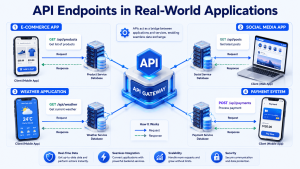
Almost every modern application that communicates with a back end uses endpoints.
For example, the endpoints of a social media application might include the following:
GET /posts
POST /posts
GET /posts/100
POST /posts/100/comments
POST /posts/100/like
Endpoints of the banking application may include accounts, transactions, payments, and authentication.
The food delivery application can include the endpoints like restaurants, menu, orders, payments, and delivery status.
The endpoints provide the application with the means to communicate with the back end.
The Difference Between an API and an API Endpoint
Although API and API endpoint are related terms, there are certain distinctions between them.
API stands for a set of all the rules and interfaces that allow applications to communicate.
Endpoint is one of the access points of an API.
Consider API as a building, whereas the endpoints are doors to different rooms in the building.
To be able to use APIs effectively, it is important to know what an endpoint is because all the accesses to the resources and their operations are defined through endpoints. Having created the correct endpoints, it is time to connect the applications via API integration.
Here is the concluding part that sums up the main points of this article.
Conclusion
APIs make up the basis of communication among the software applications that are used nowadays. They provide websites, mobile applications, servers, and other services with the means to exchange information and accomplish tasks without disclosing the inner workings of the applications.
There are many API approaches including REST, GraphQL, SOAP, and WebSockets. Knowledge of requests, responses, endpoints, authentication, and API access models provides a good starting point for API use.