
1. What Is FastAPI?
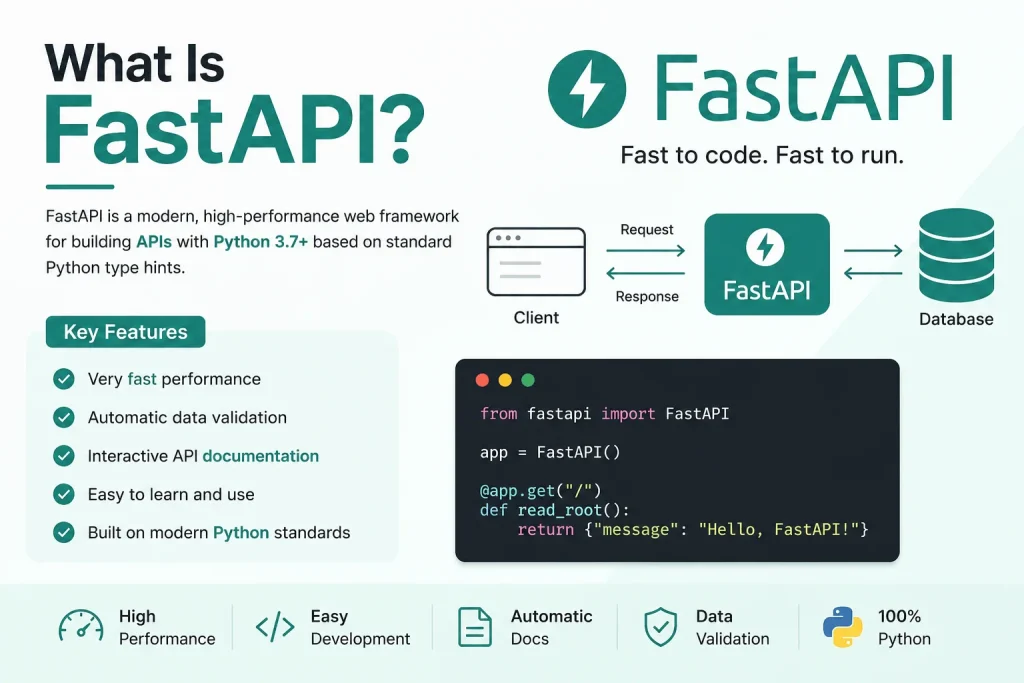
FastAPI is a high-performance web framework that helps developers build APIs with Python. FastAPI lets developers create backend services quickly. FastAPI keeps code clean, reliable and easy to maintain.
An API or Application Programming Interface, allows different software programs to talk to each other. For example a mobile app can use an API to send a login request to a server. The server processes the request. Sends back the needed data.
FastAPI is specifically made for building these types of APIs.
A Python Framework for APIs
FastAPI gives developers the tools to create API endpoints without starting from scratch. Developers can define routes receive user data, requests, connect to databases and return responses.
For example a simple FastAPI endpoint may look like this:
python
from fastapi import FastAPI
app = FastAPI()
@app.get(“/”)
home():
return {“message”: “Hello, World!”}
Here FastAPI() creates the application. The line @app.get(“/”) defines an endpoint that answers a GET request.
When a client visits the endpoint FastAPI returns data, in JSON format.
Why Is FastAPI Popular?
FastAPI has become popular because it brings together the simplicity of Python with performance. It works well for backend services and large-scale applications alike.
Some of its features are:
High performance when handling API requests
Automatic data validation
Automatic interactive API documentation
Type hints for clearer and safer code
Support for asynchronous programming
Easy integration with databases and authentication
Simple and readable development style
These features help reduce development time and make APIs easier to test and maintain.
FastAPI vs Traditional Python Frameworks
Python has well-known web frameworks, like Django and Flask. FastAPI takes an approach by focusing on API development and modern Python features.
Django is often used when developers need a featured web framework with built-in tools such as an admin panel, authentication, templates and an ORM. Flask is lightweight and flexible. Developers usually need to add extra tools for validation and API documentation.
FastAPI concentrates on building modern APIs. This makes it especially useful, for applications, web applications, microservices and AI-powered applications.
What Can You Build With FastAPI?
FastAPI can serve as the backend, for different types of applications and I have seen it work well.
For example developers can use FastAPI to build:
REST APIs
app backends
E-commerce APIs
Authentication systems
Social media backends
Microservices
AI and machine learning APIs
Real-time application services
Data-processing services
A Flutter application for example can communicate with a FastAPI backend to handle user accounts, database operations, file uploads and other server-side functionality, which I have used in my projects.
FastAPI in Modern Application Development
FastAPI is especially useful when an application requires a Python-based backend that delivers performance and modern API features.
A common setup might look like this:
Flutter/Web App → FastAPI → PostgreSQL
The frontend takes care of the user interface. FastAPI manages the business logic. Handles all API requests. PostgreSQL stores the data for the application.
This separation makes it possible to develop and maintain each part of the app on its own without affecting the others.
In the following sections we can take a look, at how FastAPI works what its main features are, the benefits it offers how to install it and how to create your first API.
2. How Does FastAPI Work?
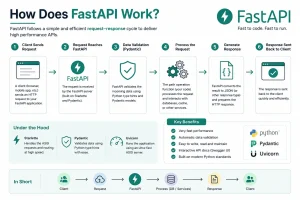
FastAPI acts as a bridge between your client application and your server‑side logic.
FastAPI takes in requests handles them checks the data runs your application code and sends a reply back to the client.
I find that FastAPI makes this flow clear and fast.
For instance a Flutter app might ask FastAPI to create an user.
FastAPI receives that request verifies the submitted data, talks to the database and sends back a response.
FastAPI does all this quickly and reliably.
The Basic Request–Response Flow
A typical FastAPI application follows this path:
Client → FastAPI → Validation → Application Logic → Database → FastAPI → Client
Each step plays a clear part.
FastAPI orchestrates them smoothly.
Client sends a request
A web or mobile app sends an HTTP request to a FastAPI endpoint.
FastAPI listens for that request. Knows what to do next.
FastAPI receives the request
FastAPI looks at the requested URL and HTTP method, such as GET, POST, PUT or DELETE.
FastAPI then routes the request accordingly.
Request data is validated
FastAPI uses Python type hints and Pydantic models to confirm that the data received matches the expected format.
FastAPI rejects data before it reaches your core logic.
Application logic runs
Your Python code handles the request.
This can include authentication, calculations, business rules or other tasks.
FastAPI gives you a way to write this code.
Database operations are performed
If needed, FastAPI talks to a database such, as PostgreSQL, MySQL or MongoDB.
FastAPI connects to the database and fetches or stores data as required.
FastAPI creates the response
FastAPI turns the result into a reply in JSON format.
FastAPI serialises the data so the client can understand it.
Client receives the result
The frontend uses the reply to refresh the app or show information to the user.
FastAPI delivers the data so the user sees the updated content.
FastAPI Routes
Routes show FastAPI how to answer URLs and HTTP methods. I find this clear.
For example:
from fastapi import FastAPI
app = FastAPI()
@app.get(“/users”)
get_users():
return {“users”: [“Anas” “Ali” “Ahmed”]}
In this example /users is an API endpoint. When a client sends a GET request to this endpoint FastAPI runs the get_users() function. I think this helps.
You can make routes for different operations:
@app.get(“/users”)
def get_users():
@app.post(“/users”)
def create_user():
@app.put(“/users/{user_id}”)
def update_user(user_id: int):
@app.delete(“/users/{user_id}”)
def delete_user(user_id: int):
This structure keeps APIs easier to understand. I appreciate how tidy this looks.
HTTP Methods, in FastAPI bold
FastAPI supports HTTP methods used by REST APIs. I like how FastAPI covers these methods.
GET. Retrieve information
POST. Create information
PUT. Update existing information
PATCH. Partially update information
DELETE. Remove information
For example a social media app might use GET to get posts and POST to create a new post. I see this in apps.
Automatic Data Validation
One of FastAPIs features is automatic request validation. It saves a lot of code.
You can define the expected structure using a model:
from pydantic import BaseModel
class User(BaseModel):
name: str
age: int
You can then use this model in an endpoint:
@app.post(“/users”)
def create_user(user: User):
return user
FastAPI checks the incoming data against the model. If the data does not match the expected structure FastAPI automatically returns a validation error. It keeps my code clean.
This reduces the need to manually check every field in your code. I feel relieved.
Asynchronous Request Handling
I find that FastAPI also supports Pythons async and await syntax.
For example:
python
@app.get(“/products”)
async get_products():
products = await fetch_products()
return products
I think asynchronous programming can be useful when an application spends a lot of time waiting for operations such, as database queries, network requests or external services.
It means FastAPI can therefore handle applications where many requests may be waiting on I/O operations at the same time.
FastAPI and Databases
I also note that FastAPI itself does not force you to use a database. You can connect it with database technologies and libraries.
A common architecture is:
Frontend → FastAPI → SQLAlchemy → PostgreSQL
FastAPI handles the API layer. SQLAlchemy can handle database interaction while PostgreSQL stores the applications data.
I see that this separation makes it easier to replace or modify parts of your backend as the application grows.
Automatic API Documentation
FastAPI is able to generate automated API documentation based on the routes, parameters and data models you define. FastAPI will automatically generate automated API documentation.
FastAPI will be particularly helpful when developing applications since you do not have to create a front end to test your API.
In addition, the documentation allows other developers to learn how FastAPI functions.
A Simple Example
The Fast API application shown below demonstrates the main workflow:
from fastapi import FastAPI
from pydantic import BaseModel
app = FastAPI()
class product(basemodel):
name: str
price: float
@app.post(“/products”)
def create_product(product: Product):
return {
“message”: “Product created”
“product”: product
}
When a client sends product information to /products FastAPI will handle it:
Receives the request.
Reads the JSON data.
Validates the data using the Product model.
Runs the endpoint function.
Returns a JSON response.
This simple process forms the foundation of larger FastAPI applications.
Understanding this request-and-response workflow makes it easier to understand FastAPI features, architecture and advantages in the sections that follow.
3. Key Features of FastAPI
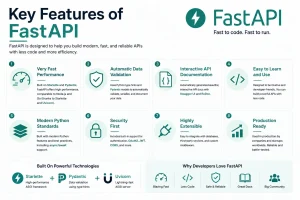
FastAPI stands out because it mixes speed, automatic checks, new Python tricks and tools that feel friendly to developers. These tricks help with both APIs and big backend systems.
1.High Performance
FastAPI is made for API work. It uses Starlette for web stuff. Pydantic for checking data.
It also lets you program with Python’s async and await. This helps when an app talks a lot to the internet like database lookups, network calls or other API requests.
Fast speed is a reason that FastAPI is often chosen when a quick backend is needed.
2.Automatic Data Validation
FastAPI can automatically check data that comes in with a request.
Developers write the expected shape using Python type hints and Pydantic models:
from import BaseModel
class User(BaseModel):
name: str
email: str
age: int
If a client sends wrong or missing data FastAPI spots the issue and returns a clean validation error.
This cuts out checking code and stops bad data from reaching the main logic.
3.Automatic API Documentation
FastAPI builds docs from your routes and models.
You can use the docs to:
– View endpoints
– See required parameters
– Understand request and response formats
– Send test requests
– Inspect API responses
This is handy when building an API that mobile apps, websites or other developers will use.
4.Python Type Hints
FastAPI uses Python type hints a lot.
For example:
@app.get(“/users/{user_id}”)
def get_user(user_id: int):
return {“user_id”: user_id}
Here user_id is supposed to be an integer.
Type hints make the code clearer. Let FastAPI use that info for checking and docs.
5.Asynchronous Programming
FastAPI supports both async functions.
A route can be written like:
@app.get(“/items”)
async get_items():
return {“items”: []}
The async syntax lets developers work with async libraries and I/O.
This helps apps that talk to databases other APIs, files or network services.
6.Dependency Injection
FastAPI has a dependency injection system.
Dependencies let you reuse work across endpoints, such as:
– User authentication
– Database sessions
– Permission checks
– Common request parameters
– Shared logic
A simple example:
from fastapi import Depends
def get_token():
return “example-token”
@app.get(“/profile”)
def profile(token: str = Depends(get_token)):
return {“token”: token}
This keeps code modular and easier to maintain.
7.Security Features
FastAPI gives tools for API security.
Developers can use authentication like:
– OAuth2
– Bearer tokens
– API keys
– HTTP authentication
For instance an app can require an access token before letting a user reach a protected route.
FastAPI gives the building blocks. The developer must still set up secure authentication, permission checks, password handling and other good practices.
8.Easy Integration With Databases
FastAPI does not force a database.
It can work with systems and libraries. For example a backend might use:
– FastAPI + SQLAlchemy + PostgreSQL
FastAPI manages HTTP requests and responses SQLAlchemy talks to the database and PostgreSQL stores the data.
This flexibility makes FastAPI fit backend designs.
9.Standards-Based API Development
FastAPI builds on web standards like OpenAPI and JSON Schema.
This lets API specs emerge automatically from your code.
These standards also make it simpler to document APIs and link them with tools.
10.Simple and Maintainable Code
FastAPI tries to keep API code short.
Of writing lots of setup and checks developers can often show the whole API structure right in Python functions and type hints.
For example:
@app.get(“/products/{product_id}”)
def get_product(product_id: int):
return {
“id”: product_id,
“name”: “Laptop”
}
The route, parameter type and response logic are all, in one place making it easy to read.
Why These Features Matter
FastAPI is more than a framework for receiving HTTP requests. FastAPI features work together to make API development faster, clearer and easier to maintain. I find FastAPI very helpful when I build services.
Automatic validation helps protect data quality and type hints improve code clarity. Automatic documentation simplifies testing processes and asynchronous support helps with I/O‑heavy applications. Dependency injection and security tools help developers structure projects more cleanly.
These capabilities make FastAPI a strong option, for Python backends, mobile applications, web applications, microservices and AI‑powered services.
4. Advantages of Using FastAPI
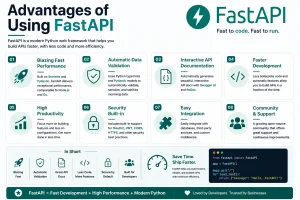
FastAPI offers benefits for developers who build modern APIs. FastAPI combines speed, simplicity, built‑in validation and ready‑made documentation. This mix makes backend work faster and easier.
Fast Development
FastAPI cuts down on the code that developers normally have to write. Python type hints tell FastAPI what data to. Fastapi uses that to auto‑create validation rules and documentation.
So developers can spend time building useful features instead of writing basic API plumbing.
Excellent Performance
Speed is one of FastAPIs points.
FastAPI runs on the ASGI platform. Supports asynchronous programming. This makes FastAPI perfect for apps that need to handle simultaneous input/output tasks.
For example an API might have to process thousands of requests that hit a database or call services. With the async libraries and design FastAPI can manage these loads efficiently.
Real‑world speed depends on the whole stack: the database, the network, the server settings and the code itself.
Less Boilerplate Code
Traditional API work often needs a lot of code for parsing requests validating data and writing documentation.
FastAPI cuts down many of these tasks.
python
from fastapi import FastAPI
app = FastAPI()
@app.get(“/users/{user_id}”)
def get_user(user_id: int):
return {“user_id”: user_id}
Built-In Validation
When data is entered incorrectly it can lead to errors or strange behavior in an application.
FastAPI uses models to check structured request data before it reaches your application code.
For example:
python
from import BaseModel
class Product(BaseModel):
name: str
price: float
quantity: int
This model sets the expected format for a product.
If a client sends data that does not match this structure FastAPI will automatically return a validation error. You do not have to write checks for every field yourself.
Automatic Documentation bold
FastAPI creates API documentation automatically from your code.
This helps during development and when working with developers. Anyone can view the endpoints what parameters they accept and what responses to expect. Without needing separate docs.
It also makes testing much easier because you can see how each API endpoint works away.
Easy to Learn for Python Developers
FastAPI relies on Python ideas such as:
Functions
Type hints
Classes
Decorators
async and await
Developers who already know Python can usually get the hang of FastAPI quickly.
You don’t need to learn a new language to start building APIs.
Supports Modern Application Architectures
FastAPI fits well with today’s backend systems.
It can be used to build:
REST APIs
Microservices
Authentication services
Mobile app backends
AI model APIs
Data-processing services
Internal company APIs
It pairs well with tools like PostgreSQL, Redis, Docker and cloud platforms.
Flexible Database Integration
FastAPI doesn’t force you to use one database.
You can pick the database that best matches your needs.
For example a project might use:
FastAPI + SQLAlchemy + PostgreSQL
Another may use a database or library entirely.
This freedom is helpful when working on apps with technical demands.
Useful for AI and Machine Learning Applications bold
FastAPI has become a go-to option for exposing machine learning and AI features through APIs.
Here’s one possible setup:
Flutter App → FastAPI → AI Model → FastAPI → Flutter App
The FastAPI server receives a user request passes the needed data to an AI model and sends the result back to the app.
This makes FastAPI ideal when you want to connect Python-based AI tools to web or mobile front ends.
Scales With Your Application
FastAPI works for projects and large systems alike.
You can begin with a few endpoints and later add:
Authentication
Database layers
Background tasks
Dependency injection
Modular routers
Caching
Testing
Containerization
Multiple services
As your app grows good structure becomes more important.. Fastapi gives you all the tools to build that structure.
When Should You Choose FastAPI?
FastAPI is a choice if you want to build a fast Python API without giving up modern features or performance.
It’s especially good if your project requires:
A high-performance API
Automatic input validation
Interactive API documentation
Async support
Python-based AI or machine learning integration
A backend for Flutter or web apps
A lightweight framework focused on APIs
FastAPI isn’t the fit for every Python project. If you need a web framework with many built-in features another tool may work better.
For API-focused apps FastAPI offers a powerful and flexible base.
Creating a web API can be hard when speed, security and development time are all important. FastAPI simplifies this process.
FastAPI is a Python framework for building APIs. It runs fast is easy to use and is made for high-performance apps. It includes API documentation and strong data validation.
What separates FastAPI from other Python frameworks?. Why are so many developers choosing it for new projects?
In this guide you’ll discover what FastAPI is, how it operates, its features, advantages and where it shines. Let’s begin with the basics.
FastAPI is a Python framework designed for building fast, dependable and scalable APIs. Its built-in validation, interactive documentation, type hints and support, for code make API development simpler and faster. It can power everything from web apps to microservices and AI-driven systems. If you’re looking for a Python framework to create modern APIs FastAPI is a solid choice to consider.