


Humanizing AI Written Articles & Content: Why It Matters
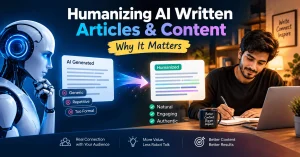
Artificial intelligence (AI) can do almost everything people can. From short-form pieces to long-form articles, social media posts, email, blog content, product descriptions, and more in a matter of minutes or hours. There’s no shortage of use cases for AI content generation software. It helps writers, bloggers, brands, marketers, and more who need content on a regular basis.
On the other hand, AI tends to generate unnatural, repetitive, wordy, boring, and generic content. It may sound right, but it lacks personality.
So, why humanizing content is necessary?
Definition of AI Generated Content
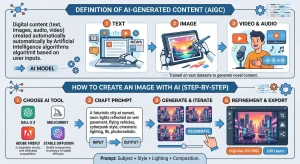
AI generated content or text refers to information or data created either partly or entirely using an external algorithm or system. An individual provides a set of instructions to a computer program capable of producing an output in the form of a document. One provides a query, question, outline, or prompt. The AI software takes it from there and produces a full-fledged introduction, conclusion, paragraphs, section headings, subheadings, and so much more.
For instance, one could ask an AI to generate an introduction. They can provide context, specify the main idea, and describe what they want the introduction to look like. The AI tool will generate somewhat decent text within a matter of seconds.
However, it requires editing, rewriting, rephrasing, and polishing to sound natural and convincing as the work of an individual.
This begs the question – why does AI-generated content soundrobotic?
Some of the major issues with AI generated text include:
Repetitiveness
Wordiness
Generic
Unnatural
Lacks fluency
Uses fillers
Plagiarism
Lacks human insight
Unnatural transitions
Predictability
Boredom
Simplicity
Emotionless
Unoriginal
Let’s take an example. An intro paragraph written by an AI writer may sound like this:
“In today’s era of accelerated digital development, the need to adopt emerging technologies becomes vital.”
On the other hand, a human writer may phrase the sentence like this:
“Technology develops at a rapid pace, so it’s critical to adapt to emerging digital trends.”
It doesn’t take an expert to infer that the second paragraph was written by a human because it uses simpler language. It lacks complex words and flowery language. It uses filler words, lacks formality, and makes the paragraph sound more personal than professional.
That brings us to our next point – why is AI content humanized?
What Does It Mean To Humanize Contents
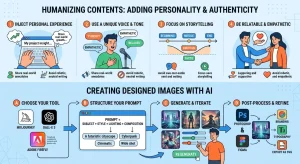
The objective of humanizing AI written text is not to make it sound less human – it is to make it sound more personal and human-like. It doesn’t necessarily entail introducing errors on purpose to make the content error-ridden or full of grammatical flaws. On the contrary, the objective is to produce text with proper grammar and correct punctuation. It should sound natural and engaging, yet informative and engaging – and most importantly, personalized. A writer must ensure that they produce content that a regular reader may find easy to read and understand.
At the same time, the rewritten version should retain the basic rules of grammar, language, context, and so on. A writer shouldn’t attempt to transform a highly complex and sophisticated text into a simplistic, poorly written piece devoid of any grammatical correctness. The whole point of humanization is to personalize content while making it simple, easy to read, understandable, clear, relevant, engaging, and not least – devoid of any signs of using chatgpt or other AI writing tools.
That brings us to our next question – how to humanize AI content?
How to Humanize AI Content
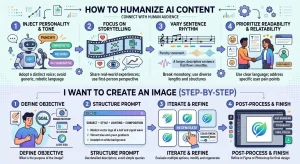
Perhaps the single most important aspect of humanizing AI content is adding the human touch to it. One of the best and most reliable ways to humanize content is to enrich it with additional information, insight, expertise, context, and so on. There are many areas where AI lacks the human touch.
Say, a beginner programmer wants to find a blog or guide about learning programming. An AI tool may write an article that talks about programming in general. However, a human writer (or a programmer) will be able to offer specific insights, such as:
Programming concepts that most people find challenging or confusing.
What programming concepts took them the longest to understand and master.
Programming resources, guides, and sources of information they wish someone had mentioned.
Programming tools they regularly use.
The most helpful and practical recommendations for first-time learners and so on.
Adding the author’s perspective, expertise, and experience helps enrich the content and provide the reader with additional information. It also adds a degree of personalization, which makes the article or guide sound less like an AI-written text and more like an authentic, personalized opinion piece.
Another excellent strategy for humanizing AI texts is to look at it as a draft. Essentially, an AI tool helps one create a first draft of an article, introduction, body paragraph, email, letter, or any other written text. Using the draft as a framework and base, one can improve upon it by rewriting, removing, deleting, adding, and modifying text to improve readability, grammar, punctuation, and overall quality.
Ultimately, it’s all about quality written content and a clear reader-focused approach.
It may be worth it to ask yourself these questions while rewriting content generated by AI:
1. “Would I say this to a fellow human being, out loud?” If the answer is no, change it until it sounds natural and like something a human would say.
2. “Would this content be valuable to someone reading it?” If the answer is no, provide context, an example, or another perspective.
3. “Does the paragraph explain concepts in a way that an individual can understand, or is there room for additional explanation?” If the answer is the latter, provide more specific examples, illustrations, analogies, and explain key ideas and terms for the audience.
The final outcome could be an informative, engaging, reader-friendly text that doesn’t sound as if it was produced by an AI. In the ideal scenario, the text should be indistinguishable from text written by an actual human.
Why You Should Focus on Humanizing AI Content
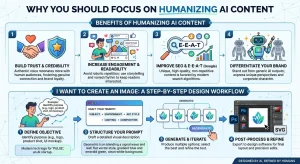
Working with AI can save you hours of writing and research. But the process usually requires a few additional steps before publishing — even when you’re just trying to publish something straightforward.
AI can generate a decent article, but readers still want something approachable, relevant, and personalized to their interests
. So how can businesses and individuals make sure that the output is humanized enough?
Humanizing AI content is especially important if you’re using AI to support your own writing. When your goal is to generate a complete article from an AI, it’s easy to let the tool dictate the writing process — rather than the other way around. This guide offers some practical tips and tricks.
Make AI Copy Sounding Natural
In your own writing, you rarely write in perfect paragraphs. You might break them up, simplify ideas, and explain things in different ways — all depending on your personality
. The same goes for humanizing AI content. If you notice that an
AI-assisted content contains repetitive parts or sentence styles, try to remove them. For instance, your first paragraph might introduce your argument, while your second paragraph supports it, then concludes to begin the next one. If your paragraphs use the same language or word patterns, you can make the article read more naturally by simplifying what’s necessary to say.
While the text above describes writing that’s closer to how an AI would write, it’s a good reminder to cut excess wording. Instead you could write:
AI-written:
“It’s vital that when you implement an effective content strategy that propels forward your online presence.”
Natural language:
“you can have a good content strategy, helping you build a stronger online presence.”
Give the Writing a Unique Style
Any decent article or piece of writing should have a personality. That doesn’t mean every piece of content has to bend towards a casual style — it all depends on context, audience, and subject material.
To humanize AI content, try determining certain qualities that make sense for the given subject. Which personality would suit this article? You can establish a writer persona based on your material and audience.
For instance, as a technical writer for developers, it makes more sense to speak in a casual tone if you’re explaining a technical concept. In a professional or formal context, more traditional language could be worth considering when humanizing your article.
Add Specific Examples
General explanation of broad terms is one of the easiest ways to make your writing sound artificial.
That’s why you might want to consider adding some examples into the mix. Rather than simply explaining a concept, try to illustrate an example to help the reader better understand your idea.
Let’s continue with an example related to Flutter development — one of our favorite subjects at Kode. Suppose you’re writing an article about developing apps withFlutter . Not only is your article full of AI-generated sentences, but you also need to include a few specific examples for your readers.
AI-written:
“Flutter is a powerful framework for creating mobile apps.”
Developer experience:
“When someone starts using Flutter, widgets can be a bit strange, seeing as practically everything is a widget. Once you’ve made a few small screen apps, however, you’ll find the system a lot less confusing.”
This addition to your article provides a genuine and approachable explanation, which is especially important when it comes to content writing.
Write With the Reader in Mind — Not the Most Important Tip
There’s a very common belief about content writing that says: “The article shouldn’t just answer questions — it should ask them. If you do that, you’ll engage the reader and get them to come back again and again.”
That’s a great rule to keep in mind in general. In this context, however, it’s useful to consider that humanizing AI content is more about making it relevant to a real person rather than publishing a self-contained piece of writing meant for search engines. Before publishing, consider any questions that your readers might ask in the comments section.
For a content post about how to humanize AI-assisted content (such as this guide), readers might wonder how to go about that process, why they should care, and what they might need to do it. Ask yourself these questions as you work on your next AI-assisted article.
Trim the Fat — Cut Unnecessary Words
Sometimes AI has a tendency to overexplain concepts — and not much else. For instance, when the AI tries to describe how to improve the quality of generated text, it’s not uncommon to see explanations like this:
“It is important to understand that in order to achieve the best possible results, you should carefully consider the various factors that may potentially influence the overall quality of your content.”
That could become something as simple as:
-To improve your content, consider the factors that affect its quality
During the editing stage, identify these unnecessarily complicated parts and replace them with straightforward phrasing. Again, keep the reader in mind.
Add Specific Details
In many cases, a good way to humanize content is to add specifics — not just to sentence structure. Consider describing specific examples, processes, observations, circumstances, and more. Specifics matter almost as much, if not more, than natural-sounding writing when it comes to humanizing an artificial piece of text.
Compare these two:
General:
“You should use examples within your content.”
Specific:
“If you’re explaining a coding concept, show a tiny code example and explain key parts of it.”
Both have valid and useful suggestions. But the specifics give your audience member more practical advice. In general, specific details help you create content that sounds less like a vague and artificial attempt compared to general explanations.
Ensure Accuracy (Especially for Fact Claims)
Accuracy is important when humanizing AI content writing — and not just for the sake of making the writing pattern look natural. Some AI writing assistants might contain inaccurate or untrue information, especially concerning specific subjects. To avoid publishing false or damaging information, always double-check claims before you publish.
That doesn’t mean that you shouldn’t change anything. In the interest of accuracy, it’s a good practice to verify facts before making any stylistic adjustments.
Avoid Questioning Information’s Truth Value
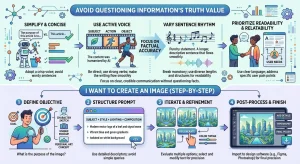
At every step, your goal should not be to make the content as undetectable as possible. That’s a common misconception about content creation — and especially content spinning or rewriting.
If anything, you should strive to make this content the most useful possible. When you make natural-sounding, engaging, and specific content, you do two big things at once:
1. You create writing that’s useful, interesting, and accurate for your target audience.
2. As a secondary effect, the created text might be harder to identify as AI-generated.
That brings us to the following point…
Consider the Reader, Not the AI Detector
The ultimate goal in the process of humanizing article content should always be to make the writing as helpful and interesting as possible for the reader. Any changes to the writing — from paraphrasing and word choice to example addition and detail specification — should be in the name of the end user’s experience. If you focus too much on making these adjustments for the sake of AI detection, then you’re likely going to miss out on making the most useful content.
Use AI in Writing — Keep Humans in Charge
An article is rarely written in one step. Even when you’re using AI to write your content, it’s probably a good idea to follow up with some fact-checking, personalization, rewriting, example adding, sentence trimming, and more. The final stage in the writing process should always be a careful review to ensure that all necessary changes have been made.
When it comes to generating content with AI, it’s important to keep in mind that AI provides the skeleton of the writing — the basic framework, outline, and structure. All the final personality and nuance stem from the person putting words on the page.
With that said, your article doesn’t need to simply be your own version of an AI writing sample. There’s a vast difference between using an AI to streamline the writing process and relying on it to plan the entire article for you, from introduction to conclusion.
Humanizing AI content is primarily an editing and revising task, with room to add specific details, examples, and unique writing touches. At the very least, keep the audience in mind while making stylistic adjustments — and keep in mind that rewriting your article isn’t the same as publishing new content based on your own writing.
Add Personality, Voice, and Storytelling to AI Content
Good content is not only about the quality of information. It is also about how the information is presented.
Two articles can have the same facts and figures but sound completely different due to the writer’s voice personality examples and storytelling. While AI can assist you in putting together the rough draft it is ultimately up to you to make the language engaging and relatable.
Develop a Writing Voice
Your writing voice is your unique way of writing. It can be chatty professional friendly boring concise wordy – you name it. There is no right or wrong in this regard – the most important thing is to pick a voice that suits your audience and stick to it throughout the article.
For instance if you are writing a beginner-friendly guide to technology-related news you might pick a more approachable voice:
“Don’t worry if widgets confuse you when you start learning Flutter. Just build a few simple screens and you will soon see how they all work together.”
Meanwhile if you are documenting the technical aspect of the same framework you are likely to go for a more formal and impersonal tone:
“Widgets are the basic building blocks of Flutter apps that enable developers to define the UI of their applications.”
Both options are perfectly fine – they simply appeal to different audiences.
Know Your Audience
Before making any changes to the AI-generated text identify your target audience. Ask yourself the following questions:
• Is your audience comprised of experts or novices?
• What are they hoping to find when they read your article?
• What jargon do they understand?
• What questions do they have?
• What kind of tone would resonate best with them?
• What would make them want to read your article?
Let’s say you want to write an article about Python for beginners. In this case you wouldn’t assume that your audience has any prior programming knowledge at all.
That means that instead of saying:
“Implement asynchronous execution via an event loop to improve the performance of I/O-heavy operations.”
you could write:
“Python can handle some operations asynchronously so that your program doesn’t have to wait for them to complete. This can be useful when you have I/O-heavy operations such as network requests.”
This way your text would be easier to grasp by someone who has no idea what asynchronous programming is.
Add Your Own Opinions
Adding your own opinions can help make the text less generic and more relatable. For instance you can state your personal preferences when it comes to learning:
“I think it is best to keep it simple when it comes to tutorials. Once the basics are clear you can move on to the more advanced concepts.”
However avoid mixing opinions with verifiable facts. Make sure to state your preferences clearly with phrases such as:
“I tend to think that…”
“In my opinion…”
“I find that…”
“You may also want to…”
“For a beginner it is best to…”
This way your text will sound more balanced.
Tell Stories
Stories can make excellent additions to your text. However you don’t have to go all out and write a hundreds-word narrative. A short paragraph will also do. For instance you can turn a bland statement about learning into a brief anecdote.
Instead of saying:
“Learning multiple things at once can overwhelm a beginner.”
you could write:
“When I was learning development I wanted to learn everything at once. However I realized pretty quickly that jumping from one framework to another and studying databases and programming languages at the same time was not effective. Instead I started focusing on one thing at a time – and it became a lot easier.”
This way the audience can relate to your experience.
Use Personal Experience (If Any)
If you have any personal experience with the topic at hand leverage it to make your article better. You can talk about:
• your positive and negative experiences
• what worked and what didn’t
• what challenges you faced
• what was easy or hard
• what pitfalls to avoid
• who you think would benefit from this article or not
• what mistakes you made and what you would do differently
• what surprised you
This information can be invaluable to your audience because it often serves as concrete examples of what to do or not do.
However avoid making things up if you don’t have any personal experience. Furthermore if you have experience always make it clear what is your personal opinion versus what is a matter of fact.
Use Specific Words and Details
The more specific the better when it comes to wording your text. For instance instead of saying:
“I had some issues with the application.”
say something like:
“On my phone the app worked fine but when I tried to upload a video that was larger than 100 MB it would not work.”
This way the reader gets a better idea of what went wrong.
Use specific words and details when talking about:
• circumstances
• conditions
• sizes
• examples
• steps
• errors
• tools
• results
These specifics will help the reader visualize and understand what you are saying better.
Use Chatty Language (in Moderation)
Chatty language is a great way to engage your audience. It makes your writing more accessible and relatable. You can use phrases such as:
“Here’s what I want to say…”
“Let’s get to it.”
“Do you have any questions so far?”
“Don’t worry if you don’t get it at first.”
“Let’s see how it works…”
However avoid going overboard and using too many chat-like phrases. This could affect your professionalism and make the reader second-guess your credibility.
Ask Questions (and Answer Them)
Asking rhetorical questions is a great way to engage with the reader. You can ask them right before revealing the answer. For instance:
“But what if I already like the way my AI text sounds?”
or
“Do you think you need to rewrite the whole article?”
Once you pose the question answer it right away. This technique can be especially effective when following your audience’s thought process.
Give Examples Instead of Definitions
If you are struggling to explain a certain concept use an example instead of a lengthy definition. For instance if you want to talk about how you can make your writing sound natural you can do so with an example. Here’s how:
Instead of writing:
“It is strongly advised to carefully analyze the generated text before publishing it.”
write:
“Before you post any AI-generated content make sure to read through it carefully to ensure that it does not sound like a computer-generated text.”
This way you get your point across more clearly and concisely.
Leverage Your Natural Writing Style
Let’s say you are a naturally chatty person with lots of opinions. In this case avoid making your articles overly formal just because an AI tool asked you to. If you tend to use lots of examples keep doing so. If you are a fan of using brief statements keep writing them.
If it helps you can even set your own rules for writing such articles. Here’s an example:
My style guide for writing these guides includes the following points:
• Keep the language simple
• Use short paragraphs
• Be friendly
• Give examples when possible
• Be straightforward and to the point
• Avoid unnecessary jargon
• Share your opinions and experiences when relevant
This way you always know what to do when you need to make your AI-generated text sound human.
Don’t Try to Sound Like Somebody Else
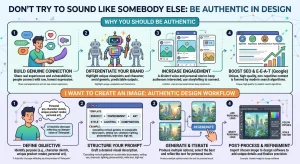
When humanizing AI content you don’t have to sound like somebody else. This could include bloggers influencers journalists or other writers. Strive to be yourself.
Of course you can sound a bit like everybody else but focus on being you first and foremost. After all it is your personality that makes your articles unique. Yes AI can help you come up with words but the opinions you include your examples and your overall writing style will always be distinctly yours.
Information + Explanation + Example + Personal Opinions
As mentioned earlier most effective humanized content follows this pattern:
Information + Explanation + Example + Personal opinions.
Here’s an example:
Information:
AI tools can help you write content faster.
Explanation:
You can use them when you need to come up with an article draft quickly.
Example:
A blogger can use an AI tool to generate a rough draft for their article.
Personal opinion:
However it is best to review the AI content before publishing it and make any necessary edits based on your own preferences.
This approach helps you get valuable information across while also adding a human touch.
Is This Human?
Once you finish editing your content read it out loud to yourself. See if you could actually say the things you wrote. If not change them.
Then ask yourself the following questions:
Does this article have a personality?
Does it provide the reader with some unique insight?
If you answered yes to these questions you are almost there.
The biggest goal when adding personality to AI content is to make it more engaging easier to read more useful and better connected to your audience.
Ultimately the best way to humanize AI content is to focus on making the language sound natural.
Introduction
Although it can be done in a matter of seconds, can artificial intelligence write an article that sounds like it was written by a human?
While AI-generated content can be precise and informative, it can also be boring, redundant, and overly robotic. Any writer would agree that these are not appealing qualities for any piece of writing.
Luckily, you don’t have to rewrite an entire article generated by an AI.
By using a few simple tricks, you can make any AI-written piece sound more human and less like a computer-generated piece. This article will show you some ways to humanize content written by an artificial intelligence while still retaining the integrity of the original piece.
Conclusion
Humanizing AI generated material is a process that is supposed to make one’s text more understandable, engaging, and informative. One is supposed to use AI tools as a source of inspiration and initial ideas and then edit one’s first draft. In order to humanize one’s AI generated text, one should also consider paraphrasing, removing all unnecessary parts, proofreading, and double-checking the information. Moreover, it is essential that one’s editing should be guided, above all, by the reader’s experience, which will transform one’s piece into an authentic and engaging statement.

