
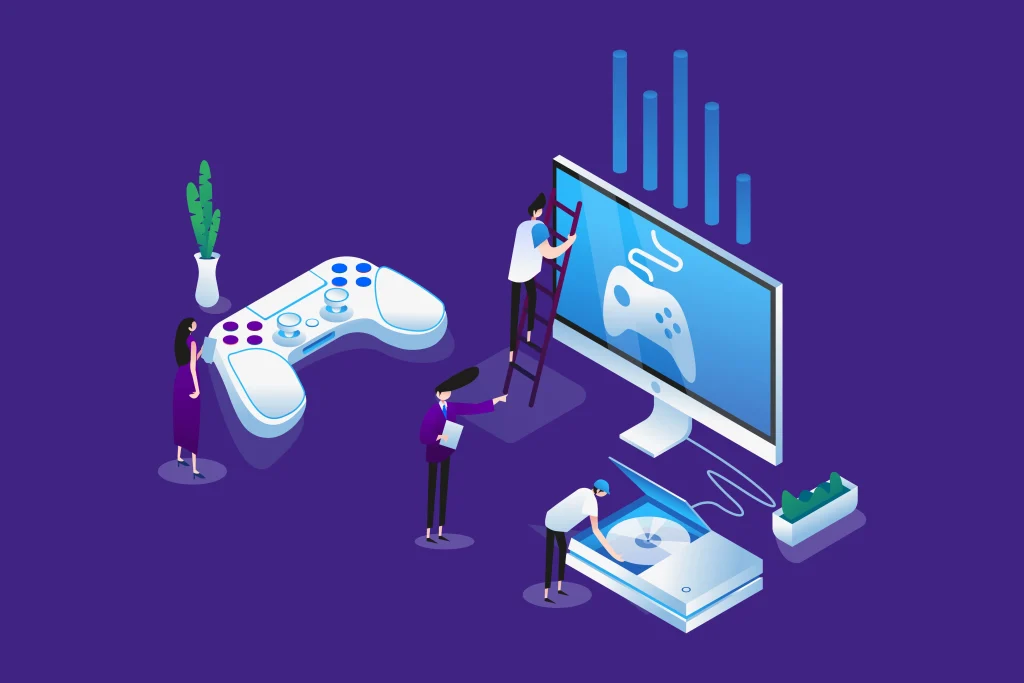

What is Game Development?
Game development is a process of bringing a video game to life.
It is creating a game from an idea to actual working product that will hopefully entertain people. It is a complex and diverse field that combines art, science, and storytelling.
A game development is a serious group activity that requires a collaborative effort and involves people with a wide range of skills.
The Core Components (“Pillars”) of a Game
It is important to understand the components of development in order to be able to understand the process itself. Most games are comprised of the following elements:
Game Design – the design of a game is its “recipe” or “blueprint.” Essentially, it is a document which dictates the rules, objectives, mechanics (the way the player controls the game world), narrative, and overall theme of the game. In short, it answers the question “is this game fun”?
Programming/Engineering – the “engineering” of a game is its coding. Programmers are responsible for bringing the design to life by giving the game its mechanics, narrative, rules, and overall structure.
Art/Animation – A game’s art style answers the question “what does the game look like?” The art and animation of a game consist of the following components:
Concept Art – designs which dictate the eventual appearance of a game
2D/3D Modeling – the creation of all characters and environments within the game
Texturing – the process of adding color and detail to 3D models
Animation – the process of bringing 3D models to life
Audio/SFX – A game’s music and sound effects answer the question “what does the game sound like?” The music and sound effects consist of the following components:
SFX – short for sound effects, these are all of the noises heard within a game, such as footsteps, gunshots, and more
Music – the background score of the game
Voice Acting – the voices of the characters heard within the game
Writing/Narrative – This component consists of all material and information which dictate the story and lore of the game.
Production/Management – This component is responsible for managing the development process and making sure that everything made it to market on time. This is the part which consists of producers scheduling and budgeting the development of the game.
The Stages of Game Development
The process can be broken down into a few key phases:
Pre-Production (The Planning Phase):
Concepting: Coming up with the idea for the game.
Pitching: Making a deck to pitch the idea to investors.
Prototyping: Making a very rough, bare-bones version of the gameplay in order to test the idea.
Creating a Game Design Document (GDD): A large, comprehensive document that acts as a reference point for the whole game.
Production (The Building Phase):
The longest and most involved part of the process, where much of the actual development takes place.
Different disciplines (artists, programmers, etc.) work in parallel to flesh out the game according to the GDD.
Levels are built, characters are animated, and code is written to bring the game to life.
Testing (QA – Quality Assurance):
Testers play the game and report any glitches they find.
They also serve as a feedback loop for balancing and tuning the game’s difficulty and fun factor.
Happens throughout production, but ramps up as the launch date approaches.
Post-Production (The Launch & Beyond Phase):
Launch: Getting the game out to the public.
Patches & Updates: Fixing the issues that slipped through QA, and occasionally adding new content.
Downloadable Content (DLC): Creating additional content for the game, usually in the form of new story chapters or characters.
Maintenance: Keeping the game’s servers up and running (in the case of online play), and ensuring the game remains compatible with newer hardware or software.
Who Makes Games? (The Team)
A single person (indie or solo dev) can make a game, but many AAA titles (such as Call of Duty or The Elder Scrolls series) have teams of hundreds of people. Some common roles in game development include:
Game Designer
Programmer (Gameplay, AI, Engine, Tools, etc.)
Artist (Concept, 2D, 3D, Animator)
Sound Designer / Composer
Writer / Narrative Designer
Producer
QA Tester
Tools of the Trade
Software
Game engines: these are the programs where games are built and designed. These engines take care of the hard parts, leaving room for the developer to focus on the game itself. Some examples are:
Unity: used to develop 2D and 3D games, mobile games, and virtual reality games. Easy to use and widely adopted.
Unreal Engine: best for triple-A games and movies due to its excellent graphic rendering.
Godot: a free and open-source rising star in the game engine space.
Programming languages: these are the textual representations of code that run games. The most common languages are C#, C++, and Python.
Art and audio software: image editing software such as Photoshop and Blender, 3D modeling software such as Maya and Zbrush, pixel art creation tools such as Aseprite, and digital audio software such as Reaper or FL Studio.
In a Nutshell
Game development is the multidisciplinary process of bringing a game from concept to a finished product that people can experience. While it can be challenging, game development is an incredibly creative and rewarding process.