

The Simple Answer
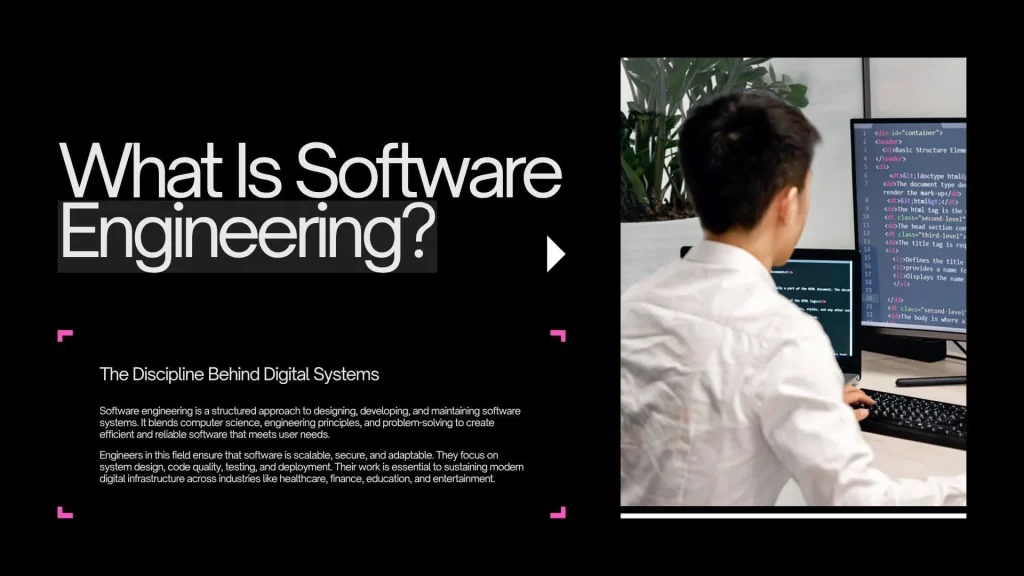
A Software Engineer is a practitioner of engineering who applies relevant, verifiable scientific, technical, and mathematical principles and methods to the design, development, testing, deployment, and maintenance of software.
Like how a carpenter can build a chair, while a structural engineer would be responsible for building an entire skyscraper; A coder can make a program, but a Software Engineer would build an entire software system.
The Deeper Breakdown Essay
1. The “Engineering” Mindset
It is essential to understand what sets computer programmers apart from the average person. One of the critical differences is the engineering mindset. It is a set of qualities that every programmer should possess:
reliability – the software works correctly regardless of circumstances,
scalability – the software is suitable for both small and large amounts of traffic,
maintainability – other developers can understand the code and improve the program without confusion,
efficiency – the code is optimized and does not require too many resources,
security – the code is protected from external attacks,
and cost-effectiveness – it is possible to develop the software within the budget and deadline.
1. What Do They Do? (The Day-to-Day)
The daily tasks of a computer programmer include analyzing requirements, designing the system, coding and implementing the software, testing and validating it, deploying and integrating the code, maintaining and updating the code, and communicating with peers and stakeholders. Thus, the job involves a wide range of activities. Although some people think that coding is the main part of the job, it is only one of the many tasks that programmers regularly perform.
In addition, the field has a lot of subdomains, so coders often specialize in a specific area. For example, a programmer can work with only the front-end of a website or work on the development of video games. One of the most popular programming languages is Python, but there are many others, including Java, JavaScript, C ++, and others.
3. Types of Software Engineers
A Front-End Engineer works on the part of the software that users see and interact with directly. They usually collaborate with UI/UX designers.
A Back-End Engineer works on the software’s inner workings. They program the servers and databases that store and process data.
A Full-Stack Engineer works on the software’s front end and back end.
A DevOps Engineer is responsible for the infrastructure for developing and maintaining the software.
A Mobile Engineer develops apps for mobile devices. They usually work in Swift (iOS) or Kotlin/Java (Android).
A Data Engineer builds systems and infrastructures to collect, store, and analyze data.
A Security Engineer detects and addresses system security threats and vulnerabilities.
An Embedded Systems Engineer programs microcontrollers in embedded systems to perform particular functions.
4. Skills Required
Technical Skills (Hard Skills) Professional Skills (Soft Skills)
Knowledge of programming languages Problem-solving skills
Understanding of data structures and algorithms Teamwork
Basic knowledge of databases Communication skills
Version control systems (Git) Flexibility and continuous learning
Operating systems (Linux, Windows) Understanding of the software development life cycle
Analogy: Building a House
The Client says: “I want a safe, comfortable, and beautiful 4-bedroom house for my family.” So, these are your requirements: safety, comfort, and 4-bedroom. You can imagine a software client saying something similar about the software they want to develop.
The Architect draws the plans for the house and thinks about how to build it. The software equivalent of an Architect is a Software Architect/Engineer. They design the software architecture and think about how to implement it.
The Carpenter, Electrician, Plumber, and others do the actual work: hanging drywall, installing electric wiring, and laying out sanitary engineering systems. Similarly, Programmers write code according to the developed architectural solution.
The Building Inspector checks whether everything is built according to the plans and up to the standard. The Software Engineer is also responsible for testing and QA (quality assurance).
The Facilities Manager does maintenance and repairs to keep everything running. Similarly, the Software Engineer works on maintaining and improving the software.
Therefore, A Software Engineer is a professional who solves complex problems by creating reliable and high-quality software that meets the client’s requirements.