
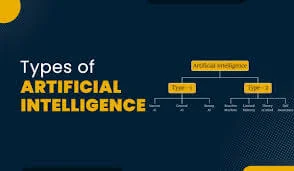

1. Types of AI Based on Capability
This classification measures how “intelligent” and human-like the AI is.
Type 1: Artificial Narrow Intelligence (ANI)
- What it is: Artificial Intelligence that is designed and trained for one specific task. This is the only form of AI that exists today in a fully realized form.
- Characteristics:
- Excels at its single task but cannot perform outside its defined parameters.
- Operates under a limited, pre-defined set of constraints.
- Examples:
- Voice Assistants: Siri, Alexa, Google Assistant.
- Recommendation Systems: Netflix, Amazon, YouTube algorithms.
- Self-Driving Car Vision Systems: Identifying pedestrians and stop signs.
- Image Recognition Software: Facial recognition on your phone.
- IBM’s Watson: Although powerful, it operates within a specific domain of knowledge and rules.
Type 2: Artificial General Intelligence (AGI)
- What it is: Artificial Intelligence that possesses the ability to understand, learn, and apply its intelligence to solve any problem at a level comparable to a human being.
- Characteristics:
- Would have reasoning, problem-solving, and abstract thinking skills.
- Could transfer knowledge from one domain to another.
- This is the type of AI often depicted in movies (e.g., Data from Star Trek).
- Current Status: Theoretical. It does not exist today, but it is the primary goal of many AI research labs.
Type 3: Artificial Superintelligence (ASI)
- What it is: Artificial Intelligence that surpasses human intelligence and ability in virtually every field.
- Characteristics:
- Would be better than humans at science, creativity, general wisdom, and social skills.
- The concept of an “intelligence explosion” or “singularity” is often associated with ASI, where AI begins to recursively improve itself beyond human control or understanding.
- Current Status: Hypothetical. This remains a topic of science fiction and long-term philosophical debate.
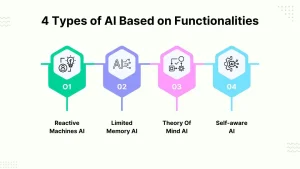
2. Types of AI Based on Functionality
This classification is based on how the AI mimics human cognitive functions and its level of self-awareness.
Type 1: Reactive Machines
- What it is: The most basic type of AI. It cannot form memories or use past experiences to inform current decisions.
- Characteristics:
- Purely reactive; it responds to the current scenario with the best possible action.
- Does not have a concept of the past or future.
- Examples:
- IBM’s Deep Blue: The chess-playing computer that beat Garry Kasparov. It analyzed the current board positions to choose its next move but did not learn from past games.
Type 2: Limited Memory
- What it is: Artificial Intelligence that can look into the past to some extent to inform its decisions.
- Characteristics:
- Uses pre-programmed data or learns from a training dataset to make better predictions.
- Most modern AI systems fall into this category.
- Examples:
- Self-Driving Cars: They observe other cars’ speed and direction (the “past” few seconds) to make immediate decisions like changing lanes.
- Large Language Models (LLMs): Like ChatGPT, which were trained on a massive dataset of text and use that “memory” to generate responses.
- Chatbots and Personal Assistants.
Type 3: Theory of Mind
- What it is: A future class of AI that can understand human emotions, beliefs, intentions, and needs, and interact socially.
- Characteristics:
- Would be able to infer the mental states of others, a crucial skill for human-like interaction.
- This is a key stepping stone toward AGI.
- Current Status: Emerging/Research Stage. While some AI can recognize basic emotions from text or voice, a true “Theory of Mind” AI does not yet exist.
Type 4: Self-Awareness
- What it is: The final stage of AI development, where machines have their own consciousness, sentience, and self-awareness.
- Characteristics:
- The AI would be aware of its own internal state, have emotions, and understand its own existence.
- This is the concept behind sentient robots in science fiction.
- Current Status: Hypothetical. This technology is far from being realized and remains a philosophical concept.
Summary Table
| Type | Based On | Description | Exists Today? | Example |
|---|---|---|---|---|
| Artificial Narrow Intelligence (ANI) | Capability | Excels at a single, specific task. | Yes | Siri, Tesla Autopilot |
| Artificial General Intelligence (AGI) | Capability | Human-level intelligence across any task. | No | N/A (Theoretical) |
| Artificial Superintelligence (ASI) | Capability | Intelligence that surpasses humanity. | No | N/A (Hypothetical) |
| Reactive Machines | Functionality | No memory, purely reactive. | Yes | IBM’s Deep Blue |
| Limited Memory | Functionality | Uses past data to inform decisions. | Yes | ChatGPT, Self-Driving Cars |
| Theory of Mind | Functionality | Understands emotions and mental states. | No (Research) | N/A |
| Self-Awareness | Functionality | Has consciousness and self-awareness. | No | N/A (Hypothetical) |
In summary, when people talk about AI today, they are almost always referring to Artificial Narrow Intelligence with Limited Memory functionality. The other types represent the exciting and challenging frontiers of future research.