
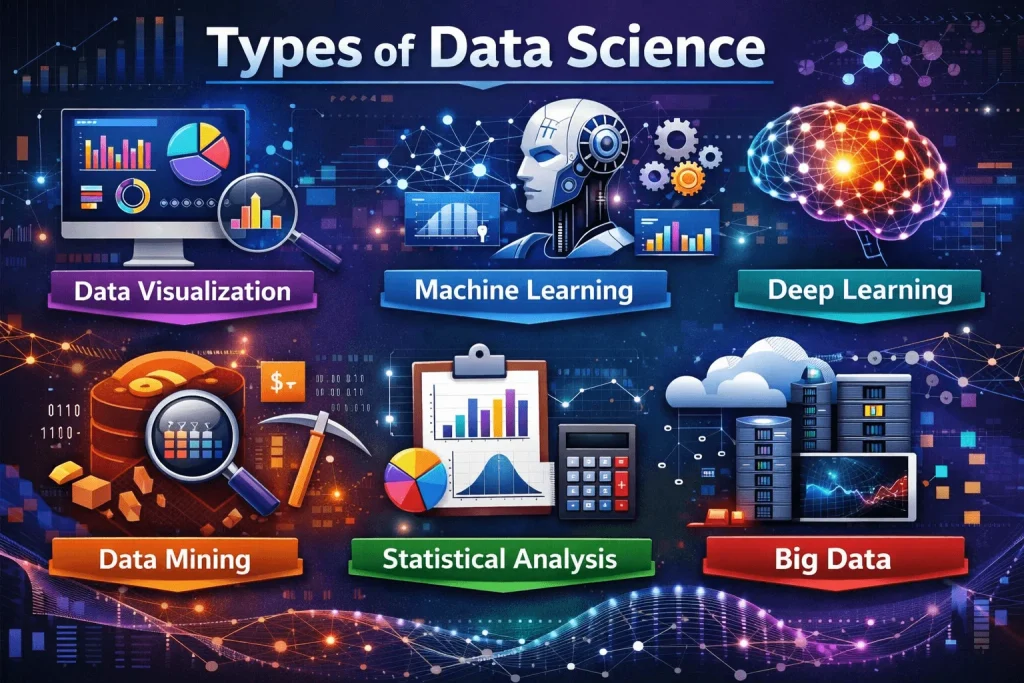

Types of Data Science: A Complete Guide to Data Science Fields
Data science has become one of the most powerful and in-demand fields in the modern digital world. Organizations rely on data science techniques to analyze large datasets, predict trends, and make data-driven decisions.
Understanding the types of data science helps businesses, researchers, and developers choose the right approach for solving complex problems. In this article, we will explore the major types of data science, their applications, and why they are important in today’s technology-driven world.
What is Data Science?
Data science is an interdisciplinary field that uses statistics, programming, machine learning, and data analysis to extract meaningful insights from data.
Data scientists work with large datasets to identify patterns, build predictive models, and support decision-making processes.
Key Components of Data Science
-
Data collection
-
Data cleaning and preprocessing
-
Data analysis
-
Machine learning modeling
-
Data visualization
-
Decision making
Major Types of Data Science
There are several types of data science techniques and approaches used across industries. Below are the most important ones.
1. Descriptive Data Science
Descriptive data science focuses on analyzing historical data to understand what has happened in the past.
Key Features
-
Summarizes historical data
-
Identifies patterns and trends
-
Uses data visualization tools
Examples
-
Sales reports
-
Website traffic analytics
-
Business performance dashboards
Descriptive analytics helps companies understand past performance and historical patterns.
2. Diagnostic Data Science
Diagnostic data science answers the question: Why did something happen?
It analyzes data to identify the root cause of events or trends.
Key Techniques
-
Data mining
-
Correlation analysis
-
Drill-down analytics
Example
If a company’s sales drop suddenly, diagnostic analysis can determine whether the reason is seasonal demand, competition, or marketing performance.
3. Predictive Data Science
Predictive data science uses machine learning algorithms and statistical models to forecast future outcomes.
Common Techniques
-
Regression analysis
-
Time-series forecasting
-
Machine learning models
Applications
-
Stock market predictions
-
Customer behavior forecasting
-
Fraud detection
Predictive analytics helps organizations anticipate future trends and risks.
4. Prescriptive Data Science
Prescriptive data science recommends the best actions based on data analysis.
It combines predictive analytics with optimization techniques to suggest solutions.
Applications
-
Supply chain optimization
-
Pricing strategy
-
Marketing campaign optimization
This type of data science helps organizations make smarter business decisions.
5. Machine Learning Data Science
Machine learning is a major branch of modern data science.
It focuses on building algorithms that learn from data and improve automatically without explicit programming.
Popular Machine Learning Methods
-
Supervised learning
-
Unsupervised learning
-
Reinforcement learning
Real-World Uses
-
Recommendation systems
-
Image recognition
-
Voice assistants
Machine learning is widely used in AI-based applications and intelligent systems.
6. Big Data Science
Big data science deals with extremely large datasets that traditional tools cannot process efficiently.
Technologies Used
-
Hadoop
-
Spark
-
Distributed computing systems
Applications
-
Social media analysis
-
Large-scale customer analytics
-
Real-time data processing
Big data science helps companies process massive volumes of structured and unstructured data.
7. Data Engineering
While not always considered a separate type, data engineering is a critical component of the data science ecosystem.
Responsibilities of Data Engineers
-
Build data pipelines
-
Manage databases
-
Prepare datasets for analysis
Data engineers ensure that clean and structured data is available for data scientists.
Applications of Data Science
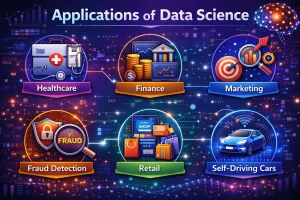
Data science is widely used across many industries, including:
Healthcare
-
Disease prediction
-
Medical image analysis
-
Drug discovery
Finance
-
Fraud detection
-
Risk analysis
-
Algorithmic trading
E-Commerce
-
Product recommendations
-
Customer segmentation
-
Demand forecasting
Marketing
-
Customer behavior analysis
-
Targeted advertising
-
Campaign performance tracking
Skills Required for Data Science
To work in different types of data science roles, professionals need several technical skills.
Essential Skills
-
Machine learning algorithms
-
Data visualization
-
Statistics and mathematics
Strong analytical thinking is also essential for solving data-driven problems.
Future of Data Science
The future of data science and artificial intelligence is extremely promising. With the rise of AI, automation, and big data, organizations will continue to rely heavily on data-driven insights.
Some emerging trends include:
-
AI-powered analytics
-
Automated machine learning
-
Real-time data processing
-
Advanced predictive modeling
These technologies will make data science even more important in business and technology sectors.
Conclusion
Understanding the different types of data science helps organizations and developers use the right analytical approach to solve problems. From descriptive and diagnostic analytics to predictive and prescriptive modeling, each type plays a unique role in extracting value from data.
As data continues to grow rapidly, the demand for data science professionals and advanced analytics solutions will continue to increase worldwide.