
The Simple Analogy: Learning from Experience
Imagine you want to teach a child what a “cat” is. You don’t give them a strict rulebook. Instead, you show them many pictures, saying “this is a cat” or “this is not a cat.” Over time, the child’s brain starts to recognize patterns—whiskers, fur, pointy ears, a certain shape—and can eventually identify a cat in a picture it has never seen before.
Machine learning is the same concept, but for computers. It’s the process of teaching a computer to learn from data and make decisions or predictions without being explicitly programmed for every single rule.
The Formal Definition
Machine Learning is a subset of Artificial algorithms (AI) that gives computers the ability to learn and improve from experience automatically. It focuses on developing computer programs that can access data and use it to learn for themselves.
The core idea is to use algorithms to identify patterns in data, build a model based on that data, and then use that model to make predictions or decisions about new, unseen data.
How Does It Work? The Basic Process
While the specifics can get complex, the general workflow looks like this:
- Data Collection: Gather as much relevant data as possible. This is the fuel for the ML engine. (e.g., thousands of labeled photos of cats and dogs).
- Data Preparation: Clean and organize the data. This involves handling missing values, removing errors, and formatting it correctly. Good data is crucial for a good model.
- Model Selection: Choose a suitable machine learning algorithm. There are many types, each good for different tasks (we’ll cover these next).
- Training: This is the “learning” phase. The algorithm is fed the prepared data. It processes this data, makes guesses, and is corrected when it’s wrong, slowly adjusting its internal parameters to improve.
- Evaluation: Test the trained model with new data it has never seen before to see how well it performs. You don’t want a model that just memorized the training data; you want one that can generalize.
- Prediction/Inference: Once the model is trained and evaluated, it can be used to make predictions on real-world, live data. (e.g., identifying a cat in a photo you just took with your phone).
- Deployment & Feedback: The model is integrated into an application. Its performance is often monitored, and new data can be used to retrain and improve it over time.
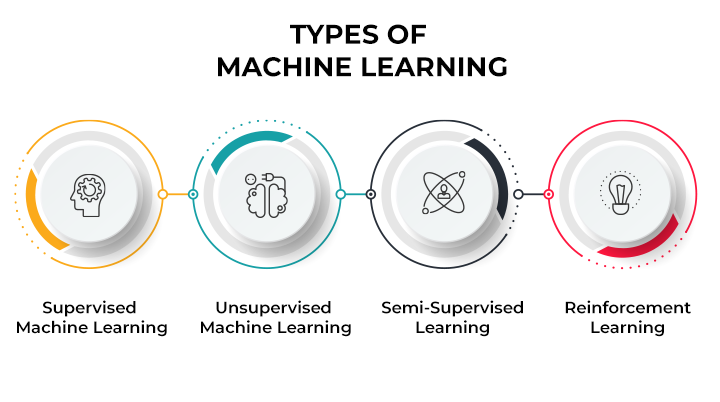
The Main Types of Machine Learning
There are three primary categories, distinguished by how the algorithm “learns.”
1. Supervised Learning
The algorithm learns from labeled data. Think of it as learning with a teacher or an answer key.
- How it works: The training data includes both the input and the correct output.
- Goal: Learn a mapping function from the input to the output so that it can predict the output for new inputs.
- Examples:
- Classification: Categorizing data (e.g., Spam vs. Not Spam email, Cat vs. Dog).
- Regression: Predicting a continuous value (e.g., Predicting house prices, stock market trends).
2. Unsupervised Learning
The algorithm learns from unlabeled data. The computer must find patterns and structures on its own, without a “teacher.”
- How it works: The system is given inputs without any corresponding outputs. It looks for hidden patterns or intrinsic structures in the data.
- Goal: Discover the underlying structure of the data.
- Examples:
- Clustering: Grouping similar data points (e.g., Customer segmentation for marketing).
- Association: Finding rules that describe large portions of the data (e.g., “People who buy X also tend to buy Y” in market basket analysis).
3. Reinforcement Learning
The algorithm learns by interacting with a dynamic environment, like training a dog with rewards and punishments.
- How it works: An “agent” makes decisions and performs actions. It receives rewards for good actions and penalties for bad ones. Over time, it learns the optimal strategy (or “policy”) to maximize its long-term reward.
- Goal: Learn a series of actions.
- Examples:
- Teaching a computer to play games like Chess or Go.
- Training robots to walk.
- Self-driving cars making real-time navigation decisions.
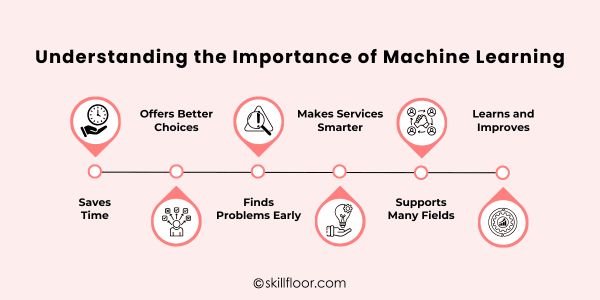
Why is Machine Learning So Important Now?
ML isn’t a new concept, but it has exploded in popularity and capability for a few key reasons:
- Massive Data: We are generating unimaginable amounts of data (from the internet, sensors, etc.). Data is the food for ML models.
- Powerful Computing: The rise of powerful, cost-effective parallel processing (like GPUs) allows us to train complex models on large datasets in a reasonable time.
- Better Algorithms: Decades of research have led to more sophisticated and efficient algorithms, especially in Deep Learning (a subfield of ML using neural networks with many layers).
Real-World Examples
You interact with machine learning every day, often without realizing it:
- Recommendation Systems: Netflix, YouTube, and Amazon suggestions.
- Voice Assistants: Siri, Alexa, and Google Assistant understanding your speech.
- Fraud Detection: Your credit card company flagging unusual transactions.
- Navigation: Google Maps predicting your ETA based on traffic patterns.
- Image Recognition: Facebook suggesting tags for your friends in photos.
- Email Filtering: Your inbox automatically sorting spam from important mail.
In short, machine learning is a transformative technology that enables computers to find hidden insights and make intelligent decisions based on data, fundamentally changing how we build software and solve complex problems.
[INSERT_ELEMENTOR id=”17″]