
1. By Overarching Philosophy (The “Big Picture” Approaches)
These are strategies that can be applied to all types of marketing undertakings.
Digital Marketing refers to the overarching marketing strategy that employs online and electronic media as a means of reaching a larger audience. It is a measurable and interactive type of marketing that utilizes various digital platforms to market and sell a certain product or service.
Traditional Marketing is another broad approach that refers to the marketing strategies that were used prior to the emergence of technological innovations. It includes various types such as print media, radio advertising, video content, telemarketing, and direct mail.
Inbound Marketing is a philosophical marketing approach that is centered around attracting customers by providing valuable content to potential buyers. In other words, this is a type of marketing that utilizes compelling content in order to lure the target market into buying a particular product or service. This type of marketing is different from others because it is about enticing customers rather than interrupting them. Content marketing falls under this category as well as search engine optimization.
Outbound Marketing , also known as interruption marketing, is a philosophical strategy that is about interrupting the target market in order to advertise and sell a product or service. Unlike inbound, outbound is more about aggressive selling wherein the seller has to get the attention of a buyer before persuading them to purchase.
Relationship Marketing is a broad-based marketing strategy that is about cultivating a good relationship with the target market in order to keep them as regular customers. This is a very customer-centric approach.
Word-of-Mouth Marketing falls under referral marketing schemes. It is a concept wherein marketing persons try to influence people to spread a certain message about a particular product, service or company. It is also considered to be the most influential marketing strategy as it relies on trust and friendship.
Guerrilla Marketing is a value-based marketing approach where companies utilize unconventional and non-traditional marketing tactics in order to maximize market outreach. It is usually implemented in a very flexible manner and could be ideal for small businesses as it could lead to virality.
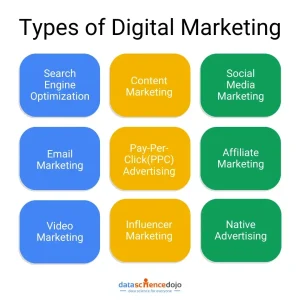
2. By Digital Channel & Tactic
These are the types of tools that are used in the modern marketing practice.
Content Marketing – refers to the practice of content creation and distribution aimed at attracting and retaining a clearly defined audience.
Search Engine Optimization (SEO) – is the process of increasing the quantity and quality of traffic from search engines by enhancing a web page’s ranking algorithms.
Search Engine Marketing (SEM)/Pay-Per-Click (PPC) Advertising – is a digital marketing strategy that uses search engines to market products or services through paid advertisements. The main idea is that the advertiser pays every time their ad is clicked on.
Social Media Marketing (SMM) – is the use of online platforms (Facebook, Instagram, LinkedIn, TikTok, X, etc.) and their tools to engage with the target audience, build brand image, and promote products or services.
Email Marketing – is a type of digital marketing that involves sending marketing emails to a segmented list of recipients. Most often, it is used to support the sales process.
Affiliate Marketing – is a type of marketing where a company pays its affiliates (partners) for every customer gained through the affiliate’s unique referral link.
Influencer Marketing – is a marketing practice where an influencer (a person with a strong social media following) promotes a brand, product, or service to their network of followers.
Video Marketing – is any marketing activity that uses video content (hosted on a website or social media pages) to engage with customers.
3. By Business Model or Context
These types are categorized by their specific business model or context:
B2B (Business-to-Business) Marketing: Marketing services for businesses. It has a long sales cycle and focuses on rational approach, value, and relationship building.
B2C (Business-to-Consumer) Marketing: Marketing services for individual customers. Its primary purpose is to persuade customers by appealing to their emotions.
C2C (Consumer-to-Consumer) Marketing: Marketing activities for selling goods or services from consumers to consumers, usually on online platforms such as eBay, Etsy, and Facebook Marketplace.
Service Marketing: Marketing intangible products such as consulting, insurance, and legal services. It focuses on building trust and credibility with the audience.
Product Marketing: Marketing tangible goods. It primarily focuses on the characteristics and benefits of the product and how it differs from similar products.
Personal Branding: Marketing people and their personal brand. It is common for consultants, speakers, and social media influencers and focuses on their authority and expertise.
4. Other Important & Niche Types
Global Marketing: Refers to the process of developing and executing marketing strategies that take into account geographical, cultural, and legal differences on a worldwide scale.
Social Media Marketing: (Also included within Digital Marketing) Refers to the use of digital platforms of the social media variety to engage one’s audience.
Viral Marketing: Short for ‘Viral Marketing,’ this is a term used to refer to the informal and unpredictable process by which certain information disseminated online can spread ‘like a virus’ to a much larger audience. This is a desired effect for many businesses, though it can be very challenging to execute.
Event Marketing: This is a strategy that is focused on creating a unique, branded experience (in either digital or physical space, such as a conference, webinar, or pop-up store) in order to engage one’s audience.
Partnership Marketing / Co-Marketing: This strategy involves two or more companies collaborating on a campaign to access, and appeal to, a previously untapped audience.
How to Choose the Right Type of Marketing
There is no single ‘best type’ of marketing, since it is always necessary to consider a combination of factors:
• The characteristics of your target audience (What platforms do they use?);
• Your own business goals (Brand awareness, customer acquisition, sales, etc.);
• The nature of your product or service (Different marketing strategies are appropriate for different levels of complexity or price range);
• Your marketing budget (Many marketing strategies are possible for a small local business, whereas an international company’s spending power might allow it to use a mix of media, including traditional advertising);
• Available resources (Do you have an in-house marketing, or will you need to outsource?).