
The Core Difference: UI vs. UX Explained
Firstly, it is essential to distinguish between the two terms.
Generally speaking, UX Design can be defined as the process of designing products (goods, services, and processes) so that the end-users have the best possible experience while interacting with the product. Meanwhile, UI Design is the process of designing a user interface of a specific product (software or an app). It concentrates mainly on the appearance and layout of elements inside the product.
To put the difference between the two terms together: UX design is more focused on processes (engineering), while the UI is more concerned with elements (painting). It means that the UI designer works with the inner structure and appearance of the product, while the UX designer works with the product as a whole. One can compare these two fields to the difference between the work of a car driver and a car manufacturer.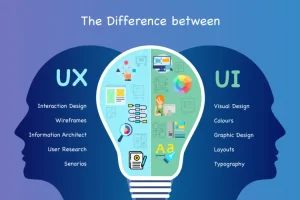
Types of UX Design Specializations
UX design is a complex process that involves many stages. Each of these stages can be specialized by a UX designer.
1. UX Research
This is the basis of the UX design since it defines most aspects of the design.
Responsibilities: Researching behavioral patterns of the target audience.
Methods: User surveys, interviews, A/B testing, usability testing, field studies.
Key question: “Who are our users, what are they looking for, and what are their behavioral patterns?”
2. Information Architecture (IA)
IA is the process of organizing and structuring the information in such a way that it provides better understanding.
Responsibilities: Creating the architecture and categorizing the information.
Methods: IA development, sitemap creation, user flows.
Key question: “How should we categorize the information?”
3. Interaction Design (IxD)
Interaction Designers design interfaces and interactions that the users have with the product.
Responsibilities: Defining interactive behaviors and designing them in prototypes.
Methods: Designing wireframes, prototype creation, developing interfaces.
Key question: “How should this element behave?”
4. UX Writing / Content Design
Content Designers create all the text elements that are used in a product.
Responsibilities: Creating text instructions for users and writing the interface text elements.
Methods: Writing text instructions and interface texts.
Key question: “What should we write so that users understand how to perform an action?”
Types of UI Design Specializations
UI design also has a number of specializations, which are mainly related to visual design.
1. Visual Design
It is actually the most common UI design specialization – the specialists who work in it are responsible for the visual aspect of the product.
Focus: color scheme, typography, icons, spacing, and images;
Key Question: “How do I make this interface look beautiful?”
2. Motion Design / Animation Design
The specialists from this UI design specialization are responsible for animations and micro-interactions in the product.
Focus: loading animations, hover effects, and screen transitions;
Key Question: “How can animation delight the user and communicate the product’s message?”
3. Brand UI Design
This is a UI design specialization that works on the intersection of brand and product design. The specialists from this field are responsible for the reflection of a brand’s visual image in a product.
Focus: developing and implementing the design system;
Key Question: “How do I communicate our brand’s personality through our product?”
Hybrid and Cross-Functional Jobs
In many companies, especially small ones and startups, the jobs mentioned above are combined. These are the most common roles one can come across when looking for employment as a UI designer.
1. Product Designer
This is also a rather broad term that combines various types of design, ranging from research to UI. A product designer is someone who is responsible for designing a product and all of its elements.
2. UX/UI Designer (the Most Common One)
This is a generalist position that combines UX and UI design.
3. Service Designer
Service designers work on a higher level – they design the whole customer journey, both digital and physical, around the product (using the app, getting support via email or phone, etc.)
Specialized & Emerging Areas
As technology evolves design specializations have also been created.
VR/AR Design: Designing immersive 3D environments for either Virtual or Augmented Reality
Voice User Interface Design: Designing for systems which are voice activated such as Alexa or Google Home
UX for AI/ML: Designing interfaces for systems which are using AI to constantly adapt and improve
Accessibility Design: Designing products for wide accessibility including users with a range of disabilities
Game UI Design: Designing the in game heads up display or HUD and other interface elements for a video game.
Summary Table
| Type of Design | Primary Focus | Key Question |
|---|---|---|
| UX Research | User needs & behaviors | “What do our users need?” |
| Information Arch. | Structure & organization | “How do we organize this information?” |
| Interaction Design | User interactions & flow | “How should this feel to use?” |
| UX Writing | Language & content | “What words should we use?” |
| Visual UI Design | Aesthetics & branding | “How do we make this look good?” |
| Motion Design | Animation & feedback | “How can motion guide and delight?” |
| Product Design | End-to-end product creation | “How do we solve this user/business problem?” |
In practice, the lines are often blurred, and a great designer usually has skills that span multiple of these areas, with a deep specialization in one or two.