

What is AI (Artificial Intelligence)?
Artificial Intelligence, also known as AI is when machines act like humans because they are programmed to think, learn and make choices, like people.
In terms AI lets computers and systems do the following:
– Learn from data
– Recognize patterns
– Solve problems
– Make decisions with minimal human intervention
SEO Keywords Used:
– What is AI
– Artificial Intelligence definition
– AI meaning
– AI technology
How Does Artificial Intelligence Work?
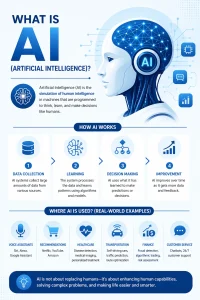
AI works by combining data, algorithms and computing power. It uses models and techniques like:
1. Machine Learning (ML)
Machine Learning enables systems to learn from data without being programmed. The more data it processes the better it performs.
2. Deep Learning
A subset of ML that uses networks to mimic the human brain. It is used in image recognition, voice assistants and more.
3. Natural Language Processing (NLP)
Natural Language Processing allows machines to understand and respond to language. Examples include chatbots and voice assistants.
4. Computer Vision
Computer Vision enables machines to interpret data such, as images and videos.
Types of Artificial Intelligence
1. Narrow AI (Weak AI)
Made to do one specific job
Examples: Voice assistants, recommendation systems
2. General AI (Strong AI)
Can handle any task a human can do
Still being worked on
3. Super AI
Smarter, than any being
Currently only a theory
Applications of AI in Real Life
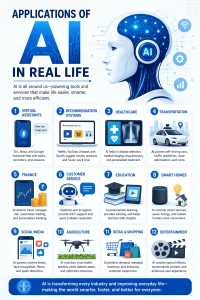
AI is used in industries today:
Healthcare
I find AI helps spot disease
I see AI look at images to find problems.
Finance
I think AI finds fraud quickly.
I notice AI runs automated trading.
E-commerce
I notice AI suggests products to shoppers.
I see AI power customer support chatbots.
Education
I find AI creates learning plans.
I see AI runs tutoring systems.
Social Media
I find AI recommends content, to users.
I see AI do face recognition.
Artificial Intelligence brings benefits. It makes tasks faster and more efficient. It can automate jobs so people don’t have to do them manually. This leads to decision-making because systems can process information in seconds. Human error is reduced since machines follow rules precisely. Artificial Intelligence systems can work around the clock without needing breaks. That means they are available 24 hours a day 7 days a week. This helps improve the way users interact with services and products. Overall Artificial Intelligence makes things smoother and more reliable.
Challenges of AI
Even though AI brings benefits it also comes with some serious challenges.
First the cost of developing AI systems is very high. It takes a lot of time, money and skilled people to build and improve these systems.
Second there is growing concern, about job displacement. As AI becomes more powerful some jobs may be replaced by machines, which can leave people without work.
Third data privacy is an issue. AI systems often rely on amounts of personal data. If that data is not protected it can be. Fall into the wrong hands.
Finally there are concerns. Who is responsible when an AI makes a mistake? How do we make sure AI treats everyone fairly? These questions are not easy to answer. They are very important.
Future of AI
The future of AI looks good. As things keep getting better AI is likely to:
Improve healthcare systems
Enable cities
Revolutionize transportation
Enhance human productivity
Conclusion
Artificial Intelligence is not a passing thing. It is the future of technology. Knowing what AI is helps people and companies stay on top in a world that is changing quickly.
No matter if you are a developer or a person who starts a business or a student learning about AI can create chances.
FAQs About AI
What is AI, in words?
AI is the ability of machines to think and learn like humans.
Is AI the future?
Yes AI is shaping the future across industries.
Can AI replace humans?
AI can automate tasks. Human creativity and decision-making are still essential.
Final SEO Keywords
What is AI
Artificial Intelligence explained
AI meaning in technology
Benefits of AI
AI applications
Future of AI