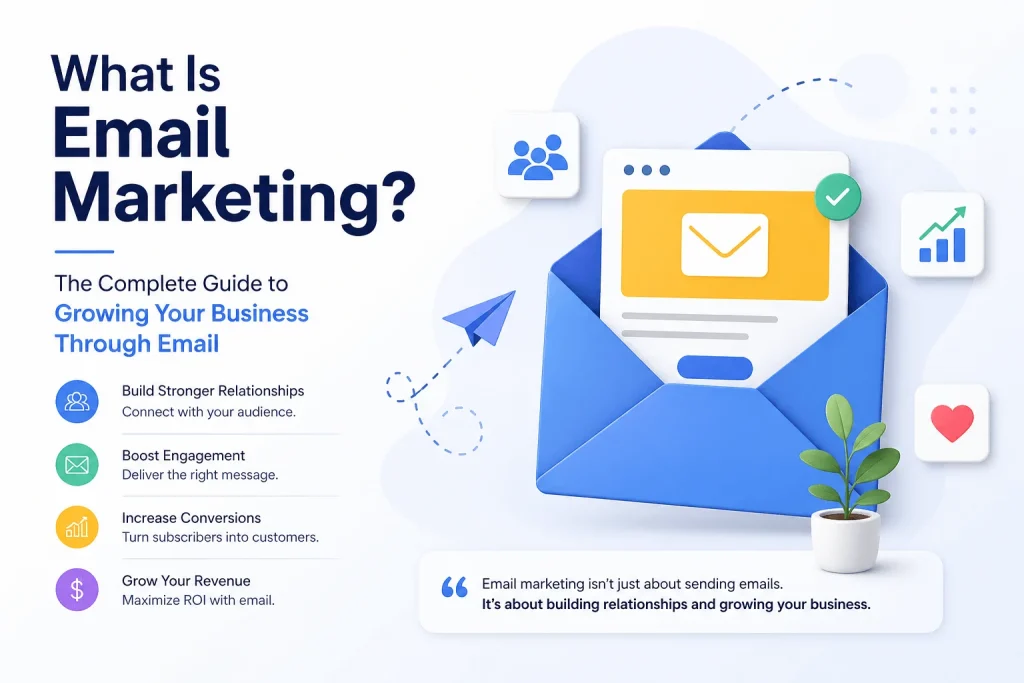

What Is Email Marketing? The Complete Guide to Growing Your Business Through Email
Email marketing remains one of the highest-ROI digital marketing channels available — delivering $36 for every $1 spent. Whether you’re a startup or an enterprise, understanding email marketing fundamentals can transform your customer relationships and revenue.
$36
4.3B
347B
21%
What Is Email Marketing?
Email marketing is a direct digital marketing strategy that uses email to promote products or services, build customer relationships, and nurture leads through a sales funnel. It involves sending targeted, personalized messages to a permission-based list of subscribers to achieve specific business goals.
Unlike social media marketing — where visibility depends on platform algorithms — email marketing gives you direct access to your audience’s inbox, making it one of the most reliable owned-media channels in digital marketing today.
SEO definition: Email marketing is the use of email communications to promote a business, build brand loyalty, and convert subscribers into paying customers — forming a core pillar of any comprehensive digital marketing strategy.
How Does Email Marketing Work?
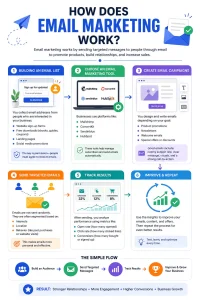
At its core, email marketing works through a simple but powerful cycle: attract subscribers → send relevant content → drive action → analyze results → repeat. Here’s how the process breaks down:
Build an email listCollect email addresses through sign-up forms, lead magnets, landing pages, or checkout flows using opt-in consent.
Choose an email service provider (ESP)Platforms like Mailchimp, Klaviyo, ConvertKit, or HubSpot handle sending, automation, and analytics.
Segment your audienceDivide your list by demographics, behavior, purchase history, or engagement to send more relevant emails.
Create and send campaignsDesign compelling emails with strong subject lines, personalized content, and clear calls-to-action (CTAs).
Measure and optimizeTrack open rates, click-through rates, conversion rates, and unsubscribes to improve future campaigns.
Types of Email Marketing Campaigns
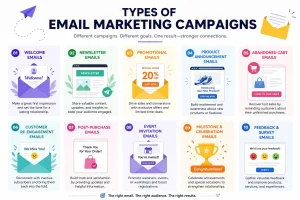
Understanding the different types of email marketing campaigns helps you choose the right approach for each business goal:
Welcome emails
Sent immediately after sign-up. They have the highest open rates of any email type — up to 82%.
Newsletters
Regular updates sharing industry news, company updates, tips, and curated content to stay top of mind.
Promotional emails
Drive sales through limited-time offers, flash sales, discount codes, or product launch announcements.
Abandoned cart emails
Recover lost revenue by reminding shoppers of items left in their cart. Average 15% conversion rate.
Drip campaigns
Automated email sequences that nurture leads over time with educational or persuasive content.
Transactional emails
Order confirmations, shipping updates, password resets — triggered by user actions on your platform.
Key Benefits of Email Marketing
Why do businesses continue to invest heavily in email marketing strategy? Here are the most impactful advantages:
Email Marketing Best Practices for 2025
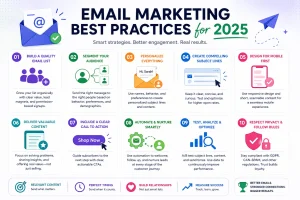
To maximize your email marketing campaign performance, follow these proven best practices:
1. Write compelling subject lines
Your subject line is the #1 factor determining open rates. Keep it under 50 characters, create urgency or curiosity, personalize with the subscriber’s first name, and A/B test variations to find what resonates.
2. Segment your email list
Segmented email campaigns get 14% higher open rates and 100% more clicks than non-segmented campaigns. Segment by purchase behavior, location, engagement level, or lead score for best results.
3. Optimize for mobile devices
Over 60% of emails are opened on mobile. Use responsive email templates, single-column layouts, large CTAs, and minimum 14px font sizes to ensure a seamless mobile experience.
4. Send at the right time
Research shows that Tuesday through Thursday mornings (9–11 AM) and early afternoons (1–3 PM) in the recipient’s time zone yield the highest open and click-through rates for most industries.
5. Comply with email marketing laws
Always follow CAN-SPAM, GDPR, and CASL regulations. This means: obtaining explicit consent, providing easy unsubscribe options, and including your physical mailing address in every email.
Email Marketing Metrics You Must Track
Measuring the right email marketing KPIs is critical for campaign optimization:
Email Marketing vs. Other Digital Marketing Channels
How does email marketing compare to other popular digital marketing strategies?
Email vs. Social media: Email delivers 40x more customer acquisition than Facebook and Twitter combined, according to McKinsey. Social media is better for brand awareness; email is better for conversion and retention.
Email vs. SEO: SEO drives organic traffic over time but takes months to yield results. Email marketing delivers immediate, controllable results to a warm audience you already have a relationship with.
Email vs. Paid ads: PPC stops the moment your budget ends. Email builds a compounding, owned asset — your list — that grows in value over time without recurring ad spend.
Frequently Asked Questions About Email Marketing
Email marketing is used for lead nurturing, customer retention, promotional offers, product announcements, brand storytelling, re-engagement campaigns, and driving repeat purchases from existing customers.
Yes — email marketing remains one of the most effective digital marketing channels. With AI-powered personalization, behavioral triggers, and advanced segmentation, email marketing is more powerful and precise than ever before.
Start by choosing an email service provider (ESP), creating a lead magnet to grow your list, building a welcome email sequence, and sending value-first content consistently. Most ESPs offer free plans for small lists under 500–1,000 subscribers.
The best platform depends on your needs. Mailchimp suits beginners; Klaviyo excels for e-commerce; ConvertKit is popular with content creators; HubSpot offers powerful CRM integration; ActiveCampaign provides advanced automation capabilities.
Most businesses send 1–4 emails per month for newsletters and 1–2 per week for e-commerce. Frequency depends on your audience and content quality — prioritize relevance over volume to minimize unsubscribes.
Ready to launch your email marketing strategy?
Get personalized advice on building, growing, and monetizing your email list — tailored to your business model and goals.
email marketing strategy email marketing campaign best email marketing tools email list building email automation email marketing ROI B2B email marketing email segmentation drip campaign email open rate marketing automation email copywriting