

What is Deep Learning? A Complete Beginner’s Guide
Introduction to Deep Learning
Deep Learning is one of the most powerful technologies in modern Artificial Intelligence (AI). It helps computers learn from data and make intelligent decisions without being explicitly programmed. Today, deep learning is used in voice assistants, self-driving cars, image recognition, medical diagnosis, and many other advanced applications.
In this blog, you will learn:
- What deep learning is
- How deep learning works
- Types of deep learning models
- Real-world applications
- Benefits and challenges
- Difference between Machine Learning and Deep Learning
What is Deep Learning?
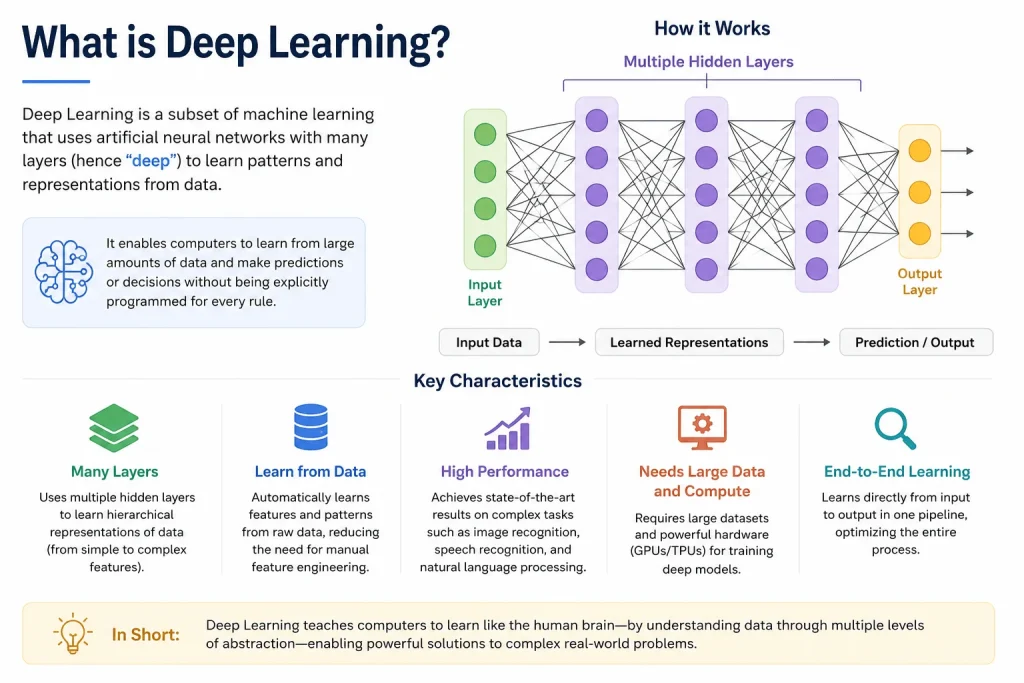
Deep Learning is a subset of Machine Learning that uses artificial neural networks to process data and solve complex problems. These neural networks are inspired by the human brain and consist of multiple layers that help computers learn patterns from large amounts of data.
Deep learning algorithms can automatically learn features from data such as images, text, audio, and videos without manual programming.
Deep Learning Definition
Deep Learning is a branch of Artificial Intelligence that trains computers to learn from large datasets using multi-layer neural networks.
How Does Deep Learning Work?
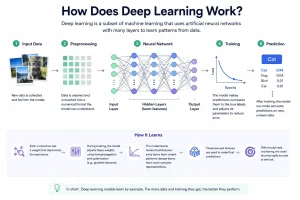
Deep learning works through layers of artificial neurons called neural networks.
Main Components of Deep Learning
1. Input Layer
The input layer receives raw data such as images, text, or audio.
2. Hidden Layers
Hidden layers process information and identify patterns. Deep learning models can contain dozens or even hundreds of hidden layers.
3. Output Layer
The output layer provides the final prediction or result.
Neural Networks in Deep Learning
Artificial Neural Networks (ANNs) are the foundation of deep learning. These networks simulate the way the human brain processes information.
Types of Neural Networks
Convolutional Neural Networks (CNN)
CNNs are mainly used for image recognition and computer vision tasks.
Recurrent Neural Networks (RNN)
RNNs are used for sequential data such as text processing and speech recognition.
Transformer Networks
Transformers power advanced AI models like chatbots and language models.
Difference Between Machine Learning and Deep Learning
| Feature | Machine Learning | Deep Learning |
|---|---|---|
| Data Requirement | Small to medium data | Large datasets |
| Feature Extraction | Manual | Automatic |
| Training Time | Faster | Slower |
| Hardware Requirement | Basic hardware | Powerful GPUs |
| Accuracy | Moderate | High |
Applications of Deep Learning
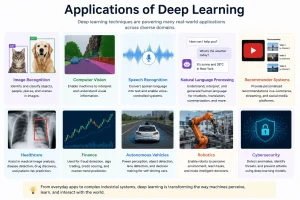
Deep learning is transforming many industries around the world.
1. Healthcare
Deep learning helps doctors detect diseases through medical imaging and diagnostics.
2. Self-Driving Cars
Autonomous vehicles use deep learning for object detection and navigation.
3. Natural Language Processing
AI chatbots and virtual assistants use deep learning to understand human language.
4. Image Recognition
Deep learning powers facial recognition systems and image classification tools.
5. Recommendation Systems
Platforms like Netflix and YouTube use deep learning to recommend content.
Advantages of Deep Learning
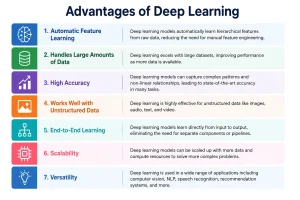
High Accuracy
Deep learning models can achieve excellent accuracy with large datasets.
Automation
It automatically learns patterns and features from data.
Advanced Problem Solving
Deep learning solves complex tasks like speech recognition and image generation.
Challenges of Deep Learning
Requires Large Data
Deep learning models need massive amounts of training data.
High Computing Power
Training deep learning models requires powerful GPUs and hardware.
Long Training Time
Complex models can take hours or days to train.
Popular Deep Learning Frameworks
TensorFlow
TensorFlow is a popular open-source deep learning framework developed by Google.
PyTorch
PyTorch is widely used for AI research and deep learning projects.
Keras
Keras is beginner-friendly and simplifies neural network development.
Future of Deep Learning
The future of deep learning is rapidly growing with advancements in Artificial Intelligence, robotics, automation, and generative AI. Deep learning will continue to revolutionize industries such as healthcare, education, finance, and entertainment.
Conclusion
Deep Learning is a powerful technology that enables machines to learn from data and perform intelligent tasks. From voice assistants to self-driving cars, deep learning is shaping the future of AI and modern technology.
If you want to start learning Artificial Intelligence, deep learning is one of the best fields to explore because of its growing demand and endless opportunities.